
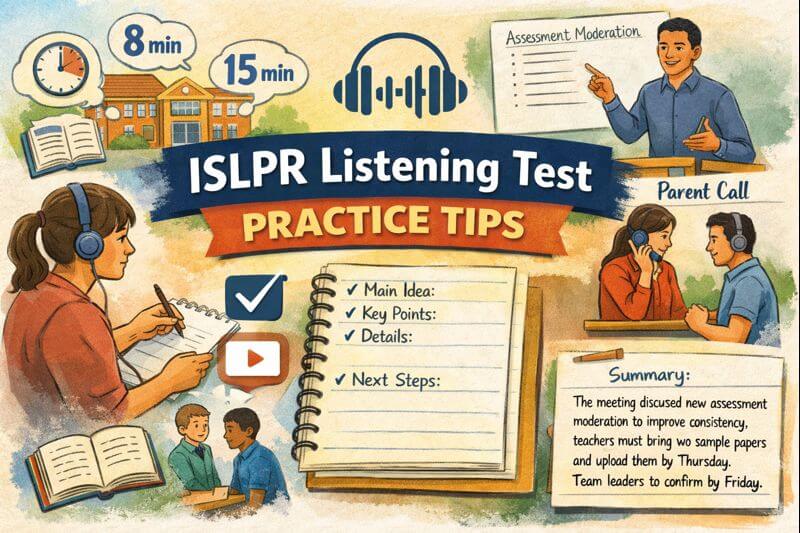
ISLPR Listening is not a memory test and it is not about catching every word. It is a professional comprehension task.
The examiner wants to know whether you can follow spoken information the way a teacher does in real life: understanding the purpose, picking out the main ideas, noticing key details, and acting on what you heard.
If your listening practice feels random, or you keep replaying audios until they feel easy, you might be building comfort rather than skill. The routine below is designed to train what ISLPR actually rewards.
Step 1: Practise with a mix of audio lengths in educational contexts
Many candidates practise only short clips under four minutes because they feel manageable. Short clips help, but they do not train sustained attention. In a school setting, messages often build over time. The speaker gives background, then a concern, then a plan, then the next steps. You must track that sequence.
Use a variety of audio lengths, all linked to education:
- 1 to 4 minutes: a daily notice, a short teacher instruction, a quick classroom explanation, a brief parent update.
- 4 to 8 minutes: a year level meeting update, a learning support discussion, a wellbeing check in, a short professional learning segment.
- 8 to 15 minutes: a staff meeting section, a longer professional learning talk, a curriculum briefing, a leadership update with multiple action items.
Illustration:
A 2-minute audio might say, “Tomorrow’s assembly is moved to 2:00 pm and teachers need to bring their classes early.”
A 10-minute audio might start with why the assembly changed, then outline supervision roles, then explain how to manage wet weather, then finish with who emails whom and by when. Both are “listening”, but they test different muscles.
Step 2: Choose audio that sounds like real school communication
You want listening input that matches school life in tone and vocabulary. Practise with these common scenarios:
- A teacher explaining a task, a concept, or classroom expectations
- A principal giving a briefing on a change in procedure
- A learning support teacher discussing adjustments
- A parent phone call about attendance or behaviour
- A wellbeing team update
- A staff meeting segment about assessment and reporting
Illustration:
Imagine a deputy principal saying, “We are tightening moderation because last term we had inconsistencies across classes.” That phrase “tightening moderation” is the kind of natural workplace language that appears in professional contexts. Your practice should include it.
Step 3: Use the three listen method, not endless replays
Repeating an audio ten times until it feels easy can trick you into thinking your listening is improving, when it is actually familiarity improving. Use repetition like a tool.
- First listen, test mode: no pausing, no replaying, take brief notes only.
- Second listen, check mode: confirm main points, repair gaps, correct misunderstandings.
- Third listen, detail mode, optional: listen again only to catch specific details you missed, such as names, dates, numbers, steps, reasons.
Then stop and move on.
Illustration:
You listen to a staff briefing once and you write “excursion forms due Wednesday”. On the second listen, you realise it was “risk assessments due Wednesday, consent forms due Friday”. That correction is exactly how your listening improves.
Step 4: Take notes using a simple structure that mirrors workplace thinking
Good notes are not a transcript. They are a map. Your notes should answer: What is happening, why is it happening, what matters, what happens next?
Use this one page template:
Context:
Speaker roles:
Purpose: inform, explain, request, decide, report, instruct
Main idea (one sentence):
Key points (3 to 5):
Important details: names, dates, numbers, steps, reasons
Outcome or decision:
Next actions: who does what by when
Vocabulary to reuse: 2 to 4 phrases
One improvement point: what you missed and why
Illustration with a typical staff meeting audio:
- Context: Staff meeting
- Speaker roles: Deputy principal
- Purpose: explain new moderation process
- Main idea: The school is standardising assessment moderation to improve consistency.
- Key points: bring 2 marked samples, use shared rubric language, upload to folder by Thursday, raise concerns early.
- Details: Weeks 4 and 5 timetable, 45 minute session, folder name “Moderation 2026 Term 1”.
- Next actions: team leaders confirm attendance by Friday.
Notice how these notes are practical. They are the notes you would actually use at work.
Step 5: Write a one paragraph summary every day
Summarising trains you to select meaning and organise it quickly. ISLPR rewards clear, controlled communication.
Use 5 to 7 sentences in this order:
- Context and purpose
- Main point 1
- Main point 2
- Main point 3
- Key detail or evidence
- Outcome and next steps
- Optional tone and implication
Example summary, staff meeting scenario:
This audio is set in a staff meeting and the deputy principal explains a new moderation process to improve consistency in assessment. The main points are that each team must bring two marked student samples for comparison and discussion. In addition, teachers are expected to use the agreed rubric language when writing feedback to students.
The speaker also stresses that concerns should be raised early, before reports are drafted. Key details include a moderation timetable running in Weeks 4 and 5 and a requirement to upload samples to the shared folder by Thursday afternoon.
As a result, team leaders will confirm attendance and upload completion by Friday, and staff should be ready to adjust grades if the moderation discussion identifies gaps. The tone is firm but supportive, suggesting the focus is accountability and quality improvement.
Step 6: Check accuracy with a transcript, or with targeted re listening
If a transcript exists, use it after you summarise. Compare and highlight:
- Ideas you missed completely
- Places you misunderstood
- Details you confused, especially dates and numbers
- Key phrases you can reuse
If there is no transcript, listen again to only the section you missed and update your notes. Keep this focused. You are training precision.
Step 7: Build a weekly routine that makes progress visible
Consistency beats intensity. Here is a simple weekly structure:
- Monday to Thursday: one audio per day, notes plus one paragraph summary
- Friday: review day, redo two older summaries from one listen only, then compare
- Weekend: one longer audio, focus on sustained attention and action items
Illustration:
On Friday, you might replay a parent phone call you did on Monday. If your second attempt captures the purpose, the concern, and the next step more clearly, you are improving in a measurable way.
Step 8: Practise the skills ISLPR is actually checking
In every session, train your ear to listen for:
- Purpose, what is the speaker trying to achieve
- Main ideas, what are the big points
- Sequence, what happens first, next, and last
- Reasons and consequences, why something matters
- Action items, who does what by when
- Tone, concerned, firm, supportive, urgent
Example summary, parent phone call scenario:
This audio is a phone call between a classroom teacher and a parent, and the purpose is to discuss a student’s attendance and engagement and agree on a support plan. The teacher explains that the student has missed several mornings over the past two weeks and is falling behind in reading groups and task completion.
The parent shares that the family has had morning transport issues and the student has been tired, which has affected routine and punctuality. The teacher suggests practical strategies such as a consistent bedtime, a simple morning checklist, and a quick check in at school on arrival.
Key details include the number of missed sessions, the impact on upcoming assessments, and an offer of wellbeing support if needed. As a result, they agree to monitor attendance over the next fortnight and meet next week to review progress and decide whether further support is required. The tone is respectful and solution focused, showing that the goal is partnership rather than blame.
Final note
Train yourself to succeed on the first listen, then use one or two repeats to learn from mistakes. Keep everything in educational contexts, use structured notes, and write one paragraph summaries daily. Over time, you will notice that you need fewer repeats, your notes become cleaner, and your summaries become more accurate and professional.