
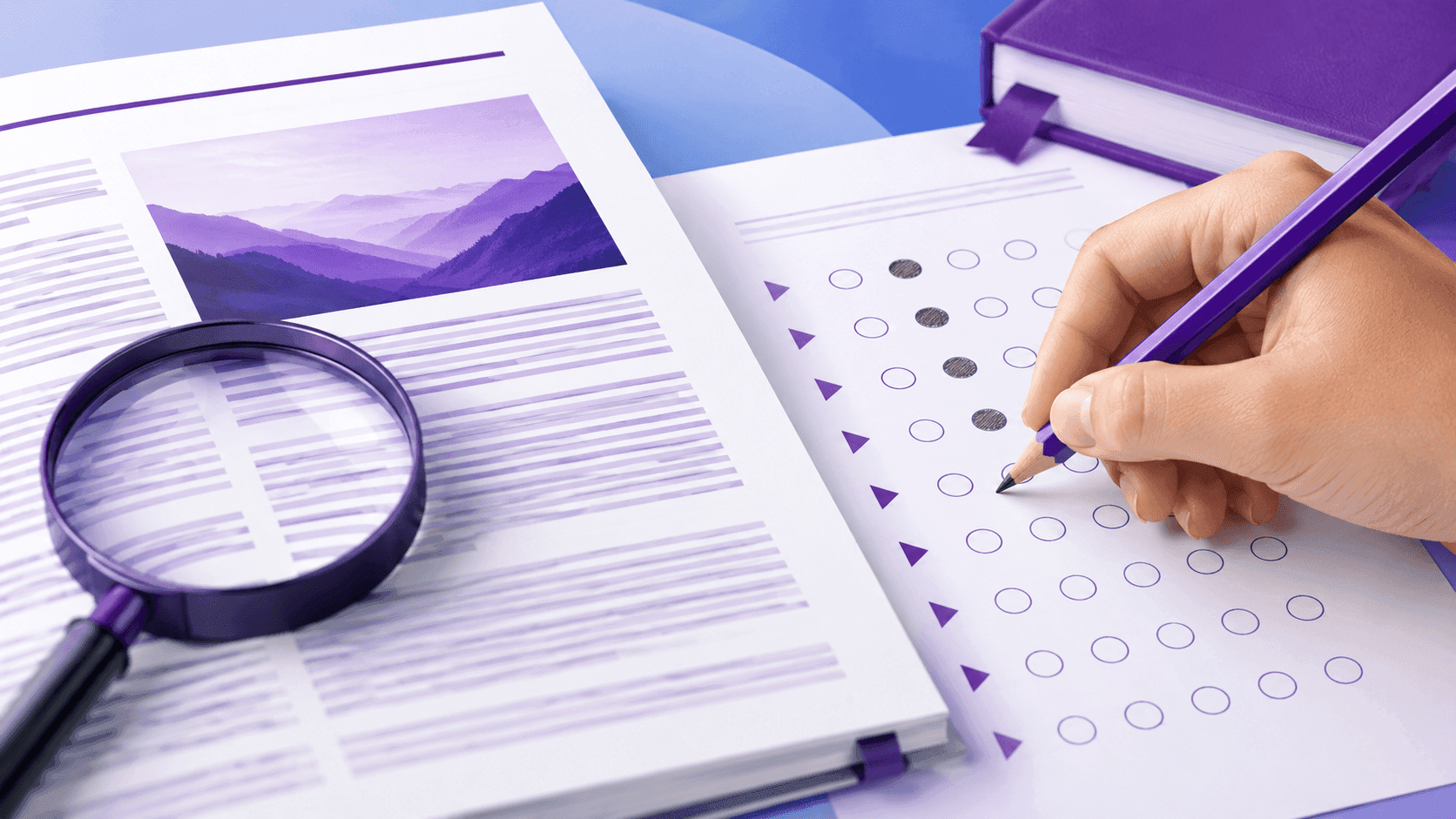
Multiple-choice questions are among the most challenging question types in the IELTS Academic Reading test. They may appear straightforward because the possible answers are provided, but several options are often deliberately written to look convincing.
An incorrect option may repeat words from the passage, include a detail that is true but irrelevant, or express only part of the correct answer. This can make it difficult to distinguish the option that accurately reflects the writer’s meaning.
The most reliable IELTS multiple-choice strategy is therefore:
Find and understand the answer in the passage before studying the answer options closely.
This guide explains the format of IELTS Reading multiple-choice questions and presents a practical three-step method for answering them accurately.
Further, I have included a copy of the text for the example question.
What Are Multiple-Choice Questions in IELTS Reading?
In IELTS Academic Reading, a multiple-choice task may require you to choose one answer from four alternatives. In other questions, you may need to select two or three answers from a longer list.
The question may be written as:
- a complete question; or
- an incomplete sentence that must be completed with the best option.
Official IELTS guidance confirms that candidates may be asked to choose one answer or more than one answer, depending on the instructions. The questions generally follow the order of information in the passage. This means the answer to an earlier multiple-choice question will normally appear before the answer to the next question.
Single-Answer Multiple-Choice Questions
A single-answer question usually gives four options labelled A, B, C and D.
The instruction may say:
Choose the correct answer, A, B, C or D.
The task may use a complete question:
Why did the researchers reject the original proposal?
Alternatively, it may use an incomplete sentence:
The researchers rejected the original proposal because…
In both formats, only one option provides the best answer.
Multiple-Answer Questions
Some IELTS Reading multiple-choice questions require more than one answer.
The instruction may say:
Choose TWO correct answers.
or:
Choose THREE correct answers.
Read this instruction carefully. In a Choose TWO question, you must identify two separately supported answers. Finding one correct answer is not enough, and selecting an additional option without textual evidence can cost you the mark.
Official IELTS practice resources provide examples of both one-answer and multiple-answer tasks.
How to Answer Multiple-Choice Questions in IELTS Reading
A common mistake is to read every answer option before searching the passage. This introduces several competing ideas and may influence how you interpret the text.
Instead, use the following three-step IELTS Reading multiple-choice strategy.
Step 1: Read and Analyse the Question
Begin by reading the question stem without studying all the options closely.
Identify:
- the main subject of the question;
- the type of information required;
- important keywords and phrases;
- limiting words; and
- possible synonyms and paraphrases.
For example, consider this question:
Why are improvements in membrane permeability unlikely, by themselves, to produce substantial further reductions in the total energy consumption of mature seawater reverse-osmosis plants?
The question word why tells you to look for a reason or explanation.
The central subject is improvements in membrane permeability, but several limiting phrases narrow the question:
- by themselves suggests that membrane improvements may help but cannot solve the entire problem;
- substantial further reductions suggests diminishing returns rather than no improvement at all;
- total energy consumption directs attention to the whole desalination plant;
- mature plants suggests established or already optimised facilities.
You should also predict possible paraphrases. For example:
- improvements in membrane permeability may become increasing water permeability;
- substantial further reductions may become dramatic reductions;
- total energy consumption may become system-level energy consumption;
- mature plants may become established plants or already optimised facilities.
This preparation helps you recognise the relevant information even when the passage uses different vocabulary.
Step 2: Skim and Scan to Locate the Answer Zone
Next, skim and scan the passage to find the section containing the answer.
Skimming means reading quickly to understand the passage’s general organisation. Focus on the title, opening sentences, repeated concepts and changes in topic.
Scanning means searching for specific keywords, synonyms and related ideas from the question.
For the desalination question, you might scan for:
- membrane permeability;
- membrane resistance;
- overall energy demand;
- established plants;
- osmotic pressure; and
- efficiency gains.
Suppose you locate a paragraph containing the following statements:
“Membrane resistance now represents only one component of overall energy demand.”
“An apparently dramatic improvement in permeability may translate into only a marginal reduction in the total energy consumption of an already optimised plant.”
These phrases closely match the wording and meaning of the question. You have now located the answer zone.
Do not choose an option yet. Skimming and scanning help you find the relevant paragraph, but detailed reading is required to understand the exact answer.
Step 3: Read in Detail and Choose the Answer
Read the identified paragraph slowly and connect its key phrases directly to the question.
The phrase “only one component of overall energy demand” explains why improvements in permeability by themselves cannot produce major reductions in total energy consumption. The phrase “only a marginal reduction” directly matches the idea that substantial further reductions are unlikely.
The paragraph may also explain that other processes—such as intake pumping, pretreatment, post-treatment and water distribution—continue to consume energy. In addition, even an ideal membrane cannot remove the pressure required to overcome seawater’s osmotic pressure.
You can therefore form an answer before reading the options:
Improved membranes affect only one part of the system. Other operations still use energy, and the pressure required to overcome osmosis cannot be eliminated.
Now return to the alternatives and choose the option that expresses this meaning accurately.
Do not simply select the option containing the most repeated words. The correct answer may use a paraphrase, while a distractor may copy vocabulary directly from the passage.
Common IELTS Reading Multiple-Choice Mistakes
Reading the Answer Options Too Early
The options can overload you with competing information. Analyse the question first and locate the answer zone before comparing the alternatives.
Searching Only for Exact Keywords
IELTS Reading tests your ability to recognise meaning expressed through paraphrase. Search for synonyms, related concepts and grammatical changes rather than identical wording.
Choosing the First Relevant Detail
A sentence may mention the correct topic without answering the precise question. Always check how the detail connects to the question stem.
Selecting a Partly Correct Option
A distractor may begin with an accurate statement but add an exaggeration or unsupported claim. Every important part of the option must agree with the passage.
Using Your Own Knowledge
Choose the answer supported by the text, even when another option appears scientifically or logically possible. IELTS assesses your understanding of the passage, not your previous knowledge of the topic.
Ignoring Limiting Words
Words such as mainly, first, most likely, by themselves and according to the writer can completely change the required answer.
Conclusion
Multiple-choice questions become more manageable when you stop trying to judge every option immediately.
Start by analysing the question. Skim and scan the passage to locate the answer zone. Then read that section in detail and establish what the writer means before returning to the alternatives.
Distractors are designed to look convincing, but they cannot mislead you as easily when you already know the answer supported by the passage.
With regular practice, this disciplined IELTS Reading strategy can help you read more efficiently, recognise paraphrases and select answers using clear textual evidence rather than guesswork.