

An article is one of the writing types that may appear in the ISLPR Writing Test. To write a strong article, it is important to understand that you are not simply answering a question for an examiner.
You are writing for a particular audience, for a specific purpose, and in a style that would be suitable for a real publication such as a newspaper, magazine, journal or school newsletter.
This means that a successful ISLPR article should do more than demonstrate correct grammar and vocabulary.
It should also show that you can organise ideas clearly, choose an appropriate tone, develop your points effectively and communicate naturally with the intended reader.
In these notes, we will examine the main parts of an article step by step. We will use one ISLPR-style question throughout and gradually build the article from the title to the final conclusion.
Definition of an Article
The official ISLPR website defines an article as:
“A paper or statement similar to the sorts of articles that appear in newspapers, journals or magazines.”
Comments on the Definition
This definition gives us important clues about what an article should look like in the ISLPR Writing Test.
An article is written for readers. It should sound like something that could realistically appear in a newspaper, magazine, journal, school newsletter or another publication.
There is no single style of article. The language and tone depend on:
- who will read the article;
- where the article will appear;
- why you are writing it; and
- what the task asks you to discuss.
For example, an article for parents may be warm, clear and accessible, while an article for a professional teaching journal may use more formal and specialised language.
Before writing, always identify:
TOPIC + AUDIENCE + PURPOSE + TEXT TYPE
Example ISLPR-Style Question
We will use one question throughout these notes and gradually build the article section by section.
Many students are spending increasing amounts of time using mobile phones and other digital devices.
Write an article for your school newsletter explaining some of the effects excessive screen use can have on students and suggesting what parents and schools can do to encourage healthier technology habits.
Analysing the Question
Text type: Article
Audience: Parents and members of the school community
Publication: School newsletter
Purpose: Explain and advise
Topic: Excessive screen use
Content required:
- effects on students;
- what parents can do;
- what schools can do.
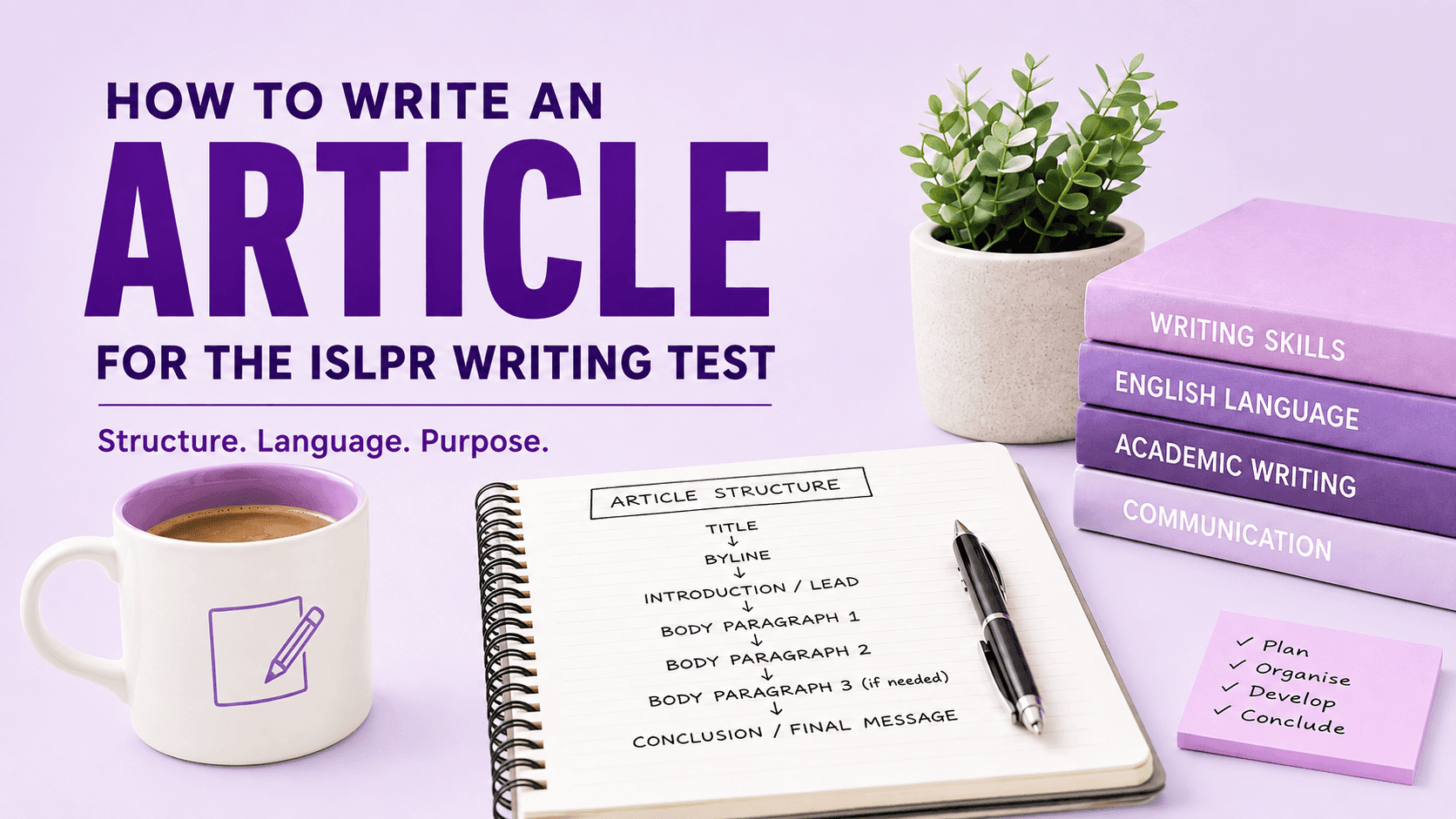
Structure of an Article
A useful structure is:
Title
↓
Byline
↓
Introduction / Lead
↓
Body Paragraph 1
↓
Body Paragraph 2
↓
Body Paragraph 3 — If Needed
↓
Conclusion / Final Message
The number of body paragraphs should depend on the task. In our example, three body paragraphs work well because the question contains three main content areas.
Title
The title, sometimes called the headline, appears at the top of the article.
Its purpose is to:
- tell the reader what the article is about;
- attract the reader’s attention; and
- create an appropriate introduction to the subject.
A good title should be:
- clear;
- relevant;
- reasonably short;
- appropriate for the audience.
Language of the Title
An article title does not normally need to be a complete sentence.
It can use:
- a clear statement;
- a question;
- an interesting phrase; or
- a direct reference to the issue.
For example:
Helping Students Develop Healthier Screen Habits
or
Are Screens Taking Over Our Children’s Lives?
For our school newsletter audience, the first title is clear, professional and suitable.
Building Our Example
At this stage, our article looks like this:
Helping Students Develop Healthier Screen Habits
Byline
The byline identifies the writer of the article.
It normally appears immediately below the title.
A simple format is:
By Ronald Kaunda
Articles in newspapers, magazines, newsletters and online publications commonly include a byline.
For the ISLPR test, there is no need to add unnecessary information such as your address, qualifications or contact details unless the task specifically requires them.
Building Our Example
We now have:
Helping Students Develop Healthier Screen Habits
By Ronald Kaunda
Introduction / Lead
The opening paragraph of an article is often called the introduction or lead.
Its purpose is to:
- introduce the topic;
- establish why the topic is important;
- interest the reader; and
- lead naturally into the main discussion.
The introduction should usually be fairly short.
You do not want to spend too many words introducing the issue before getting to the main points.
Language in the Introduction
An article can begin in several ways.
A direct statement
Digital technology is now a major part of children’s everyday lives.
A question
How much time does your child spend looking at a screen each day?
A problem
Many students are arriving at school tired after spending hours online late at night.
A balanced observation
Mobile phones and digital devices can be useful tools for learning, but excessive use can create problems for students.
For our article, a balanced opening works well because we do not want to suggest that all technology is bad.
Building Our Example
Our article now reads:
Helping Students Develop Healthier Screen Habits
By Ronald Kaunda
Mobile phones, tablets and computers are now an important part of children’s everyday lives. While these devices can support communication and learning, spending too much time on screens can affect students’ health, concentration and school performance. Parents and schools therefore have an important role in helping young people develop healthier technology habits.
Body Paragraph 1
The first body paragraph should develop the first major requirement of the task.
Our question first asks us to explain:
some of the effects excessive screen use can have on students
Therefore, Body Paragraph 1 should focus on the effects.
A useful structure is:
POINT
↓
EXPLANATION
↓
EXAMPLE OR RESULT
Do not simply list ideas.
Weak development
Screen use causes tiredness. It affects concentration. It can affect learning.
Better development
Excessive screen use can interfere with students’ sleep. Young people who remain online late at night may not get enough rest, which can leave them tired and unable to concentrate effectively in class.
The second version explains the relationship between the ideas.
Language in Body Paragraph 1
Useful expressions include:
- One major concern is …
- One important effect is …
- This can lead to …
- As a result, …
- This may affect …
- For example, …
- Another consequence is …
The language should remain appropriate for parents and the school community.
Avoid unnecessarily technical expressions.
Building Our Example
We now add Body Paragraph 1:
Helping Students Develop Healthier Screen Habits
By Ronald Kaunda
Mobile phones, tablets and computers are now an important part of children’s everyday lives. While these devices can support communication and learning, spending too much time on screens can affect students’ health, concentration and school performance. Parents and schools therefore have an important role in helping young people develop healthier technology habits.
One major concern is the effect excessive screen use can have on sleep and concentration. Students who stay online late at night may not get enough rest and can arrive at school feeling tired. As a result, they may find it difficult to concentrate, participate in lessons or complete their work effectively. Spending long periods on devices can also reduce the time available for physical activity, reading and face-to-face interaction.
Body Paragraph 2
The next part of the question asks:
what parents can do
Body Paragraph 2 should therefore focus specifically on parents.
This shows why careful task analysis is important. Each paragraph should have a clear purpose.
Language in Body Paragraph 2
Because we are giving advice and recommendations, useful language includes:
- Parents can …
- Parents could …
- One practical step is …
- Families can encourage …
- It may be helpful to …
- Another useful approach is …
The tone should be helpful rather than judgemental.
For example:
Too strong
Parents must stop their children from using phones.
Better
Parents can establish reasonable limits around screen use.
The second version is more appropriate for a school newsletter.
Building Our Example
Our article now becomes:
Helping Students Develop Healthier Screen Habits
By Ronald Kaunda
Mobile phones, tablets and computers are now an important part of children’s everyday lives. While these devices can support communication and learning, spending too much time on screens can affect students’ health, concentration and school performance. Parents and schools therefore have an important role in helping young people develop healthier technology habits.
One major concern is the effect excessive screen use can have on sleep and concentration. Students who stay online late at night may not get enough rest and can arrive at school feeling tired. As a result, they may find it difficult to concentrate, participate in lessons or complete their work effectively. Spending long periods on devices can also reduce the time available for physical activity, reading and face-to-face interaction.
Parents can help by establishing reasonable boundaries around technology use at home. For example, families could agree to keep phones away during meals and limit screen use before bedtime. Parents can also encourage children to take part in other activities such as reading, sport, outdoor play and family conversations. The aim should not be to remove technology completely, but to help children develop balance.
Body Paragraph 3 — If Needed
A third body paragraph is needed in our example because the question also asks:
what schools can do
This requirement should not be ignored.
Even if the first two paragraphs are excellent, the task would not be fully addressed without discussing the role of schools.
Language in Body Paragraph 3
Because we are making recommendations to schools, useful expressions include:
- Schools can …
- Schools should consider …
- Teachers can …
- One useful strategy would be …
- Schools also have a role to play …
- Another possible approach is …
Again, use measured and professional language.
Building Our Example
We now add the third body paragraph:
Helping Students Develop Healthier Screen Habits
By Ronald Kaunda
Mobile phones, tablets and computers are now an important part of children’s everyday lives. While these devices can support communication and learning, spending too much time on screens can affect students’ health, concentration and school performance. Parents and schools therefore have an important role in helping young people develop healthier technology habits.
One major concern is the effect excessive screen use can have on sleep and concentration. Students who stay online late at night may not get enough rest and can arrive at school feeling tired. As a result, they may find it difficult to concentrate, participate in lessons or complete their work effectively. Spending long periods on devices can also reduce the time available for physical activity, reading and face-to-face interaction.
Parents can help by establishing reasonable boundaries around technology use at home. For example, families could agree to keep phones away during meals and limit screen use before bedtime. Parents can also encourage children to take part in other activities such as reading, sport, outdoor play and family conversations. The aim should not be to remove technology completely, but to help children develop balance.
Schools also have an important role to play. Teachers can educate students about responsible technology use and establish clear expectations about when devices may be used during the school day. Schools can also provide opportunities for physical activity, social interaction and learning experiences that do not always depend on screens. Working with parents can help ensure that students receive consistent messages at home and at school.
Conclusion / Final Message
The conclusion is the final part of the article.
Its purpose is to leave the reader with a clear final message.
Depending on the task, the conclusion may:
- reinforce the main argument;
- make a recommendation;
- encourage action;
- summarise the central message;
- offer a solution; or
- leave the reader with an important thought.
The conclusion should not simply copy sentences from the introduction.
Language in the Conclusion
Useful expressions include:
- Ultimately, …
- For these reasons, …
- The key is …
- By working together, …
- What is needed is …
- We all have a role to play …
- With the right support, …
You do not have to begin with “In conclusion”.
Articles often finish more naturally with a strong final statement.
Building Our Example — Complete Article
Helping Students Develop Healthier Screen Habits
By Ronald Kaunda
Mobile phones, tablets and computers are now an important part of children’s everyday lives. While these devices can support communication and learning, spending too much time on screens can affect students’ health, concentration and school performance. Parents and schools therefore have an important role in helping young people develop healthier technology habits.
One major concern is the effect excessive screen use can have on sleep and concentration. Students who stay online late at night may not get enough rest and can arrive at school feeling tired. As a result, they may find it difficult to concentrate, participate in lessons or complete their work effectively. Spending long periods on devices can also reduce the time available for physical activity, reading and face-to-face interaction.
Parents can help by establishing reasonable boundaries around technology use at home. For example, families could agree to keep phones away during meals and limit screen use before bedtime. Parents can also encourage children to take part in other activities such as reading, sport, outdoor play and family conversations. The aim should not be to remove technology completely, but to help children develop balance.
Schools also have an important role to play. Teachers can educate students about responsible technology use and establish clear expectations about when devices may be used during the school day. Schools can also provide opportunities for physical activity, social interaction and learning experiences that do not always depend on screens. Working with parents can help ensure that students receive consistent messages at home and at school.
Ultimately, technology itself is not the problem; the challenge is learning how to use it responsibly. By working together, parents, schools and students can create healthier habits that allow young people to enjoy the benefits of technology without allowing it to interfere with their wellbeing and education.
Language to Use in an ISLPR Article
The language of an article should always depend on the audience and purpose.
When Writing for Parents
Use clear, respectful and accessible language.
Parents can encourage their children to develop healthier routines at home.
When Writing for Students
You may be more direct and conversational.
Your phone can help you learn, but it can also become a distraction.
When Writing for Teachers
A more professional register may be appropriate.
Consistent classroom expectations can encourage students to use digital devices more responsibly.
When Writing for a General Audience
Avoid unnecessary professional jargon.
Young people need support to develop healthy technology habits.
Use Linking Language Naturally
Linking expressions can help the reader follow your ideas.
Useful examples include:
- however;
- for example;
- as a result;
- in addition;
- another concern is;
- another possible solution is;
- for this reason;
- at the same time.
However, do not use linking words simply because you have memorised them.
They should clarify relationships between ideas.
12. Important Things to Remember
1. Read the question carefully.
Before writing, identify:
TOPIC + AUDIENCE + PURPOSE + TEXT TYPE
2. Answer every part of the task.
In our example, the candidate needed to discuss:
- effects on students;
- what parents can do;
- what schools can do.
Missing one of these means the task has not been fully addressed.
3. Give the article a clear title.
A title helps establish the text as an article.
4. Include a simple byline.
For example:
By Ronald Kaunda
5. Write a clear introduction or lead.
Introduce the topic quickly and give the reader a reason to continue.
6. Let the task determine your body paragraphs.
Do not force every article into exactly the same paragraph structure.
7. Develop your ideas.
Remember:
POINT → EXPLANATION → EXAMPLE / RESULT
8. Match your language to the reader.
Writing for parents is different from writing for teachers, students or professional readers.
9. Be engaging without becoming too informal.
Questions, direct address and inclusive expressions such as we, our, you and your can be useful when appropriate.
10. Do not force difficult vocabulary.
Clear and accurate English is more effective than complicated vocabulary used incorrectly.
11. Use linking expressions naturally.
Do not begin every paragraph with:
Firstly, secondly, moreover, furthermore, finally.
Use language that genuinely connects the ideas.
12. End with a clear final message.
A good article should leave the reader with an opinion, recommendation, encouragement or call to action.
Final Structure to Remember
TITLE
Helping Students Develop Healthier Screen Habits
↓
BYLINE
By Ronald Kaunda
↓
INTRODUCTION / LEAD
Introduce the issue and establish why it matters.
↓
BODY PARAGRAPH 1
Develop the first requirement of the question.
↓
BODY PARAGRAPH 2
Develop the second requirement.
↓
BODY PARAGRAPH 3 — if needed
Develop another important requirement.
↓
CONCLUSION / FINAL MESSAGE
Leave the reader with a clear recommendation, opinion or final thought.
Conclusion
Writing an effective article for the ISLPR Writing Test is not mainly about memorising a fixed template. It is about understanding the audience, purpose, topic and text type, then making appropriate language and organisational choices.
A strong article should have a clear title, a suitable byline, an effective introduction or lead, logically developed body paragraphs and a purposeful final message. Each paragraph should contribute directly to the task, and important ideas should be explained rather than simply listed.
Most importantly, your article should sound as though it has been written for the real readers identified in the question. Use language that is clear, accurate and appropriate for those readers. If you respond to every part of the task, organise your ideas logically and maintain an appropriate register throughout, you will be demonstrating the practical writing ability that the ISLPR test is designed to assess.

Thank you very much for the article sample. Could you please share how to create ideas in writing.
Thanks a lot for your comment. have you seen the videos here: https://www.youtube.com/watch?v=1oIW32RuBwE&list=PLoWgXVNYffV7DAMSGrFirse_mnGD4rAG4