
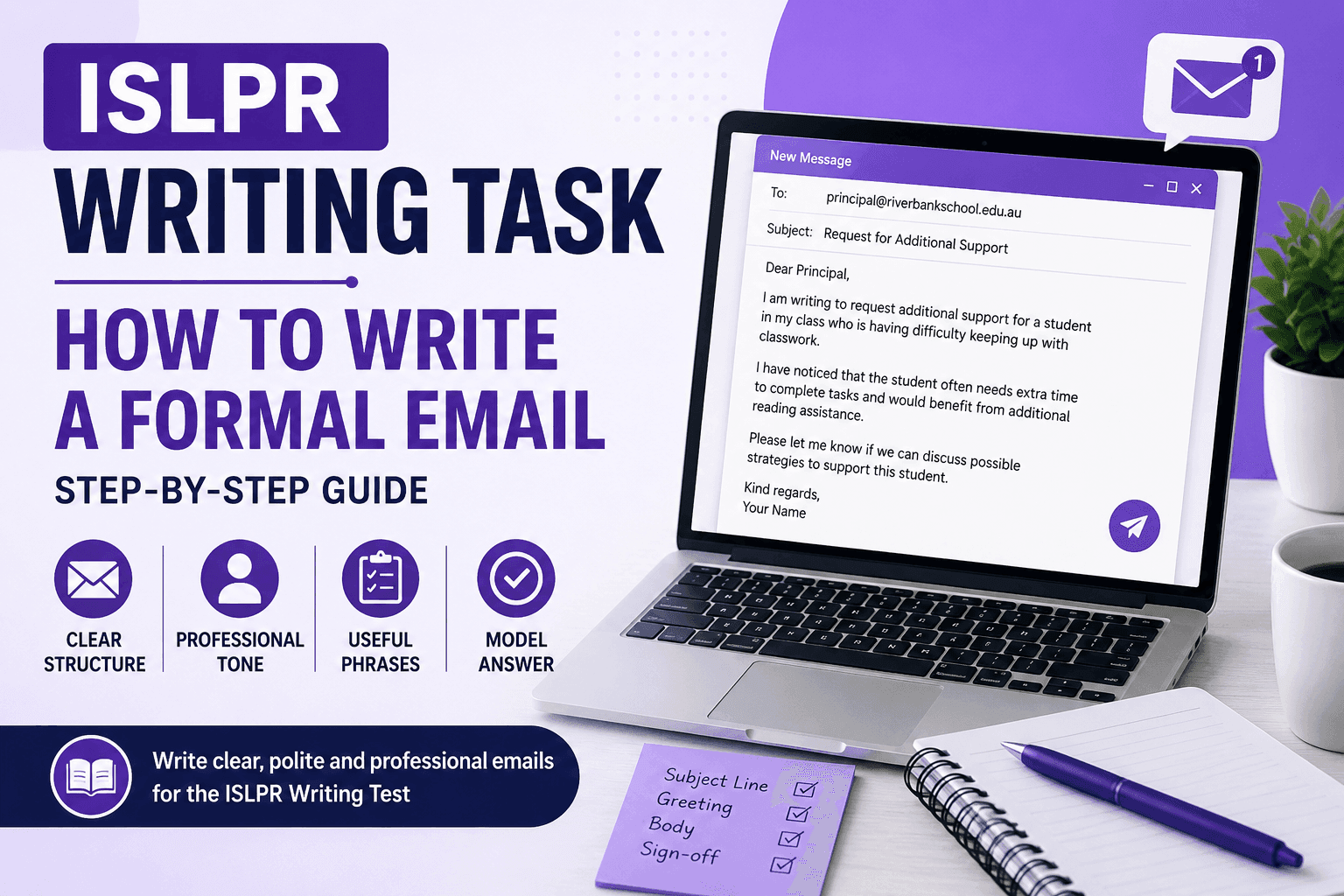
A formal email is one of the writing tasks that may appear in professional, workplace or school-based communication. In the ISLPR Writing Test, you may be asked to write to a parent, teacher, principal, manager, colleague, registration officer or another professional audience.
The purpose of this type of task is not to show off complicated English. The purpose is to show that you can communicate clearly, politely and appropriately in a realistic situation.
A strong formal email is:
- clear
- polite
- organised
- purposeful
- suitable for the reader
- complete enough to answer the task
This guide explains how to write a formal email for ISLPR Writing, step by step.
What Is a Formal Email?
A formal email is a professional written message sent electronically for official, academic or workplace communication. It uses clear structure, respectful language and an appropriate tone to communicate information, requests or responses effectively.
A formal email is usually shorter and more direct than a formal letter, but it still needs to be respectful, organised and complete.
You may write a formal email to:
- request information
- respond to a concern
- explain a situation
- apologise for a problem
- give advice or support
- make a complaint
- confirm arrangements
- ask for permission
- provide an update
In ISLPR Writing, the email must suit the situation. For example, an email to a parent should sound respectful and supportive. An email to a manager should sound professional and direct. An email to a school principal should sound polite and formal.
The Purpose of an Email
The purpose of an email is to communicate information, requests, updates or responses clearly and efficiently in written electronic form.
A formal email may be used to:
- share information quickly and clearly
- make a request
- respond to a concern
- provide an update
- confirm details
- explain a problem
- suggest a solution
- ask for action or support
In the ISLPR Writing Test, you should always ask yourself:
Why am I writing this email?
Who am I writing to?
What does the reader need to know?
What action or response is needed?
If you can answer these questions before you start writing, your email will be more focused.
Formal Email vs Formal Letter
A formal letter usually includes:
- sender’s address
- date
- receiver’s address
- greeting
- subject line
- body paragraphs
- formal closing
A formal email usually includes:
- recipient email address
- subject line
- greeting
- opening paragraph
- body paragraphs
- final paragraph
- sign-off
- sender’s name
In the ISLPR test, candidates do not usually need to invent email addresses unless the task specifically asks for them. The main focus should be the subject line, greeting, message body and closing.
Parts of a Formal Email
A good formal email has several important parts. Each part has a clear purpose.
1. Recipient
The recipient shows who the email is being sent to.
Example:
To: pr*******@*****************du.au
In the test, this may not be necessary. If you include an email address, keep it simple and realistic. Do not waste time creating complicated or unrealistic email addresses.
2. Subject Line
The subject line tells the reader what the email is about. It should be short, clear and specific.
Good examples:
- Subject: Request for Additional Reading Support
- Subject: Concern About Homework Completion
- Subject: Update on Student Participation
- Subject: Permission Request for Class Excursion
- Subject: Response to Parent Concern
Weak examples:
- Subject: Important
- Subject: Problem
- Subject: Please Read
- Subject: About Student
Weak subject lines are too general. They do not clearly tell the reader what the email is about.
A strong subject line helps the reader understand the purpose immediately.
3. Greeting
Use a polite and professional greeting.
Examples:
- Dear Ms Taylor,
- Dear Mr Singh,
- Dear Principal,
- Dear Parent or Guardian,
- Dear Registration Officer,
- Dear Sir or Madam,
Use the person’s name if it is given. If the name is not given, use the person’s title or role.
Avoid informal greetings such as:
- Hi there,
- Hello mate,
- Hey,
- Dear friend,
These may sound too casual for a formal email task.
4. Opening Paragraph
The opening paragraph should state why you are writing.
Example:
I am writing in response to your email regarding your child’s homework completion over the past two weeks.
This works because it immediately tells the reader the purpose of the email.
Your opening paragraph should be direct, polite and relevant to the task. Do not begin with long background information. The reader should know why you are writing from the first paragraph.
5. Main Body Paragraphs
The body gives the details. It may:
- explain what happened
- describe what you have noticed
- provide relevant examples
- respond to the reader’s concern
- suggest a solution
- request action or support
The body should stay focused. Do not include unnecessary information. Every sentence should help answer the task.
In many ISLPR-style formal emails, one or two body paragraphs are enough. The most important thing is to explain the situation clearly and professionally.
6. Final Paragraph
The final paragraph should explain the next step or close politely.
Examples:
- Please let me know if you would like to discuss this further.
- I would be happy to meet with you next week to review his progress.
- Thank you for your support in this matter.
- I look forward to your response.
A strong final paragraph helps the reader know what happens next.
7. Sign-Off
Use a professional sign-off.
Examples:
Kind regards,
Ronald Kaunda
Yours sincerely,
Ronald Kaunda
Regards,
Ronald Kaunda
For most formal emails, Kind regards is natural and appropriate.
Avoid casual endings such as:
- Cheers,
- Thanks mate,
- Bye,
- See ya,
These are not suitable for a formal email in an ISLPR writing task.
Simple Formal Email Structure
Use this structure in the test:
Subject: Clear topic of the email
Dear [Name or Title],
Paragraph 1: State why you are writing.
Paragraph 2: Give details, explanation or background information.
Paragraph 3: Suggest action, make a request or explain the next step.
Kind regards,
Your Name
This structure is simple, but it works. It helps you organise your ideas and keeps your writing focused.
Useful Formal Email Phrases
Using appropriate formal phrases can help you sound professional. However, do not memorise a whole email. Instead, learn useful phrases that you can adapt to different tasks.
To Begin the Email
- I am writing in relation to…
- I am writing to respond to your concern about…
- Thank you for your email regarding…
- I am writing to provide an update on…
- I am writing to request your support with…
Examples:
Thank you for your email regarding Daniel’s homework.
I am writing to provide an update on your child’s participation in group activities.
To Explain the Situation
- Over the past two weeks, I have noticed that…
- The main concern is that…
- This has affected…
- One possible reason for this may be…
- At this stage, it appears that…
Examples:
Over the past two weeks, I have noticed that Daniel sometimes needs extra time to record homework instructions.
One possible reason for this may be that he is unsure which materials he needs before leaving class.
To Suggest a Solution
- One strategy that may help is…
- I suggest that we…
- It may be useful to…
- I would recommend…
- We can support the student by…
Examples:
One strategy that may help is to use a simple homework checklist.
We can support the student by helping him record the task before the end of each day.
To Close Politely
- Thank you for your understanding.
- Thank you for your support.
- Please let me know if you have any questions.
- I would be happy to discuss this further.
- I look forward to hearing from you.
Examples:
Please let me know if you would like to discuss this further.
Thank you for your support in this matter.
Guided Example Task
Word limit: 150–180 words
You are working in a school. A parent has emailed you because they are concerned that their child is not completing homework regularly. Write a formal email to the parent explaining the situation and suggesting one practical way the school and family can support the student.
Your email should:
- acknowledge the parent’s concern
- explain what you have noticed at school
- suggest one practical support strategy
- use a respectful and professional tone
Planning the Task
Before writing, spend a short time planning. This helps you avoid going off topic.
For this task:
Audience: A parent
Tone: Respectful, calm and supportive
Purpose: Respond to the concern, explain what has been noticed and suggest a support strategy
Paragraph plan:
- Acknowledge the parent’s concern.
- Explain what has been noticed at school.
- Suggest one support strategy and close politely.
Planning is important because it helps you control your writing. A formal email should not feel random. Each paragraph should have a clear job.
Model Answer
Subject: Support for Homework Completion
Dear Mrs Williams,
Thank you for your email regarding Daniel’s homework. I understand your concern and appreciate you letting me know that he has been finding it difficult to complete tasks regularly at home.
At school, I have noticed that Daniel understands the learning activities when they are explained step by step. However, he sometimes needs extra time to record instructions and organise the materials he needs before leaving the classroom. This may be one reason why he is unsure about what to complete at home.
One strategy that may help is to use a simple homework checklist. I can help Daniel write the task, due date and materials needed before the end of each day. At home, you could use the checklist to support him as he begins his homework.
Thank you for your support. Please let me know if you would like to discuss this further.
Kind regards,
Ronald Kaunda
Why This Email Works
This email works because it:
- has a clear subject line
- uses a polite greeting
- acknowledges the parent’s concern
- explains the situation without blaming anyone
- gives a practical support strategy
- uses clear paragraphs
- ends politely
- stays within the word limit
Notice that the email does not blame the student or the parent. It explains the issue calmly and gives a practical way forward. This is exactly what professional communication should do.
Weak vs Improved Email
Looking at weak and improved examples can help you understand what to avoid.
Weak Email
Subject: Homework
Dear Parent,
Your child is not doing homework. I think you need to make sure he does it every day. He often forgets things and this is becoming a problem. Please help him more at home.
Regards,
Ronald
Why This Is Weak
This email is weak because:
- the tone sounds blaming
- the subject line is too general
- there is not enough detail
- the suggestion is not clearly supportive
- it does not sound professional
- it may make the parent feel criticised
The message is too direct in a negative way. It does not show support or professional care.
Improved Email
Subject: Supporting Homework Completion
Dear Mrs Williams,
Thank you for your email about Daniel’s homework. I understand your concern and agree that a consistent routine may help him complete tasks more confidently.
At school, Daniel responds well when instructions are broken into smaller steps. However, he sometimes needs support to record the homework task clearly before going home.
To support him, I suggest using a simple homework checklist. I can help him complete it at school, and you can use it at home to guide his routine.
Kind regards,
Ronald Kaunda
Why the Improved Email Is Better
The improved email is better because it:
- uses the parent’s name
- begins respectfully
- responds to the concern
- explains the situation calmly
- gives a practical strategy
- avoids blame
- sounds professional and supportive
This is the kind of tone you should aim for in ISLPR Writing.
Exam-Focused Tips
1. Read the Task Carefully
Before you write, identify:
- the audience
- the purpose
- the required points
- the tone
- the word limit
Do not start writing before you understand the task.
2. Use a Clear Subject Line
The subject line must match the purpose of the email.
Weak:
Subject: Problem
Better:
Subject: Concern About Homework Completion
A clear subject line shows control and professionalism.
3. Write in Clear Paragraphs
Use three short paragraphs:
- Purpose
- Explanation
- Action or next step
Paragraphing helps the reader follow your message easily.
4. Be Professional, Not Emotional
Avoid blame, criticism and aggressive language.
Avoid:
You must fix this problem.
Use:
I would appreciate your support with this strategy.
Avoid:
Your child is careless.
Use:
He may need support to organise the task before leaving school.
Professional language is respectful, realistic and solution-focused.
5. Keep It Realistic
Write as if the person will actually read and respond to your email.
Do not write sentences that sound artificial or overly memorised. Your email should sound natural, respectful and purposeful.
6. Leave Time to Check
Before submitting, check:
- spelling
- punctuation
- grammar
- tense
- sentence structure
- paragraphing
- tone
- task completion
- word limit
Many candidates lose marks because they do not leave time to check simple errors.
Practice Task
Word limit: 150–180 words
You are working as a teacher aide in a primary school. A classroom teacher has asked for your observations about a student who has difficulty joining group activities. Write a formal email to the teacher explaining what you have noticed and suggesting one practical support strategy.
Your email should:
- explain what you have noticed
- describe when the difficulty usually happens
- suggest one practical strategy
- use a polite and professional tone
Suggested Planning
Audience: Classroom teacher
Tone: Professional, respectful and supportive
Purpose: Explain observations and suggest a support strategy
Paragraph 1: State why you are writing.
Paragraph 2: Explain what you have noticed and when the difficulty usually happens.
Paragraph 3: Suggest one practical strategy and close politely.
Free ISLPR Writing Practice
To practice with more writing tasks, please visit ISLPR Writing Test, a platform where you can test yourself for free.
Final Checklist
Before submitting your formal email, ask yourself:
- Have I written a clear subject line?
- Have I used a polite greeting?
- Is my purpose clear in the first paragraph?
- Have I answered all parts of the task?
- Have I used a professional tone?
- Have I organised my ideas into paragraphs?
- Have I suggested a clear action or next step?
- Have I used an appropriate sign-off?
- Is my email within the word limit?
- Have I checked grammar, punctuation and spelling?
Key Point to Remember
A strong formal email is clear, polite, organised and purposeful. In the ISLPR Writing Test, candidates need to show that they can communicate professionally in a realistic situation.
The focus should be on:
- the reader
- the purpose
- the action needed
- the tone
- the structure
Do not try to impress the examiner with complicated English. Instead, show that you can write a professional email that a real person would understand and appreciate.