
A memo, or memorandum, is a short professional document used inside an organisation. It is usually written to inform staff, explain a change, announce a decision, give instructions or request action.
In an ISLPR writing task, a memo may appear as a workplace, school or professional communication task. This means candidates must show that they can write clearly and appropriately for a real-life situation, not just produce an academic essay.
The most important thing to remember is this:
A memo is judged by how quickly and clearly the reader can understand the message and know what to do next.
A strong memo is not emotional, wordy or essay-like. It is practical, direct, organised and professional.
What Is the Purpose of a Memo?
A memo has one main job: to communicate important information efficiently.
In a professional setting, the reader is usually busy. They do not want long introductions, personal stories or unnecessary explanations. They want to know:
- What is this memo about?
- Why is this information important?
- What are the key details?
- What do I need to do?
- When do I need to do it?
For ISLPR candidates, this is important because a memo tests practical written communication. The examiner wants to see whether you can control your language, organise information clearly and write appropriately for a professional audience.
Memo Writing Is Not Essay Writing
Many candidates make the mistake of writing a memo like an essay. This usually weakens the response.
An essay develops an argument or explores ideas in depth. A memo gives information or instructions in a clear and efficient way.
A memo should not include:
- long essay-style paragraphs
- emotional language
- casual greetings
- unnecessary storytelling
- vague instructions
- repeated ideas
- overly polite phrases such as “I humbly wish to inform you”
Instead, a memo should be:
- brief
- organised
- direct
- specific
- professional
- easy to scan
In simple terms, a memo should help the reader act, not make them work hard to find the message.
The Standard Memo Format
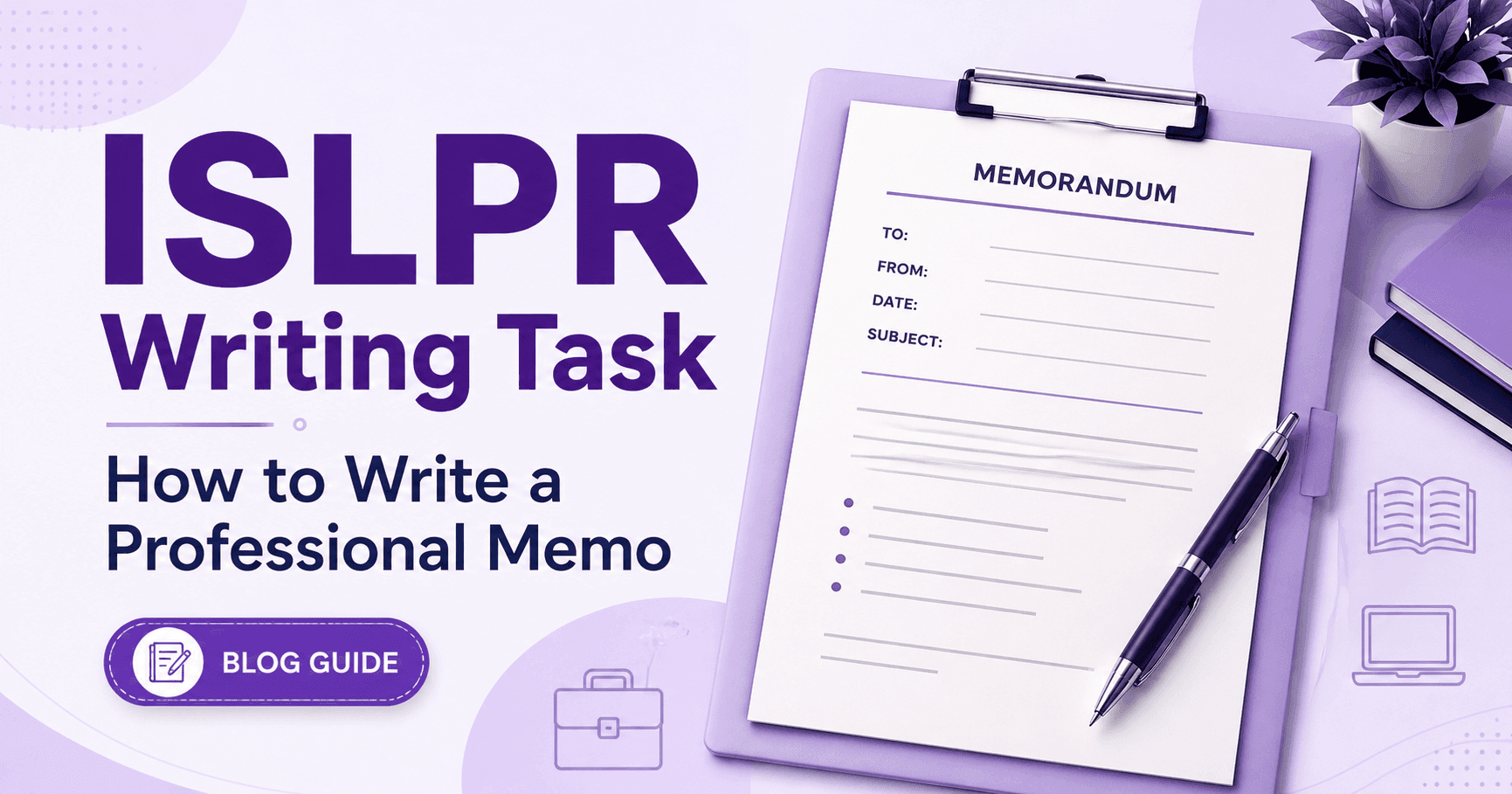
A professional memo usually begins with four standard header fields.
These are:
TO:
The person, group or position receiving the memo.
FROM:
The name and position of the person writing the memo.
DATE:
The date the memo is written.
SUBJECT:
A short, specific summary of the memo topic.
Example
TO: All Teaching Staff
FROM: Maria Evans, Deputy Principal
DATE: 26 June 2026
SUBJECT: Implementation of New Student Mobile Phone Policy
This header is important because it immediately tells the reader who the memo is for, who wrote it, when it was written and what it is about.
A memo should not begin with “Dear Staff” or “Hi everyone”. It should also not end with “Yours sincerely”, “Kind regards” or “Best wishes”. Those features belong more naturally in letters and emails, not formal memos.
Writing a Strong Subject Line
The subject line is one of the most important parts of a memo. It should be clear and specific.
A weak subject line is vague.
Weak examples
SUBJECT: Phones
SUBJECT: New Rules
SUBJECT: Staff Information
SUBJECT: Changes
These subject lines do not tell the reader enough.
Strong examples
SUBJECT: Implementation of New Student Mobile Phone Policy
SUBJECT: Changes to Afternoon Student Pick-Up Procedures
SUBJECT: Updated Yard Duty Roster for Term 3
SUBJECT: Introduction of New Staff Reporting Procedures
A strong subject line helps the reader understand the purpose of the memo immediately.
The Four-Part Memo Body Structure
A strong memo normally has four clear parts:
- Purpose
- Background or context
- Key information
- Required action or next steps
Using this structure helps the candidate organise ideas logically and avoid writing unnecessary information.
1. Purpose Statement
The first sentence should state the purpose of the memo directly.
Do not begin with a long greeting or general comment. Go straight to the point.
Weak opening
I hope everyone is doing well. I just wanted to write this memo because there have been some issues recently and we thought it would be good to let everyone know what is happening.
Strong opening
The purpose of this memo is to inform all teaching staff of the new student mobile phone policy, which will take effect from Monday, 20 July 2026.
The strong version is clearer because it immediately explains the topic and gives the start date.
2. Background or Context
After stating the purpose, briefly explain why the memo is being written.
This section should give enough background for the reader to understand the situation. However, it should not become a long explanation.
Example
The policy has been introduced in response to increased reports of mobile phone use during class time. Teachers have reported that unauthorised phone use is affecting student concentration, classroom behaviour and learning time.
This gives the reason for the policy without becoming emotional or repetitive.
3. Key Information or Details
This is the main part of the memo. It explains the rules, changes, procedures or important information.
For readability, use short paragraphs, bullet points or numbered points. This is especially useful when presenting instructions.
Example
From the commencement date, the following rules will apply:
- Students must keep mobile phones switched off and stored in their bags during lessons.
- Phones may only be used during class if the teacher has given permission for a learning activity.
- Students must not use phones to record, photograph or message others during school hours.
- Repeated breaches must be recorded on the school behaviour management system.
This is stronger than placing all the information in one long paragraph because the reader can quickly identify each rule.
4. Required Action or Next Steps
The final section should explain what the reader must do next.
This is where many candidates lose marks because they explain the issue but forget to give clear instructions.
A strong memo should include:
- who must act
- what they must do
- when they must do it
- who to contact if they need help
Example
All teaching staff are required to review the full policy document on the shared staff drive before Friday, 17 July 2026. Any questions should be directed to the Deputy Principal’s office.
This is clear because it gives a specific action, a deadline and a contact point.
ISLPR-Style Practice Task
Writing Task
You are the Deputy Principal at Green Valley Secondary School. The school is introducing a new mobile phone policy because teachers have reported increased distraction during class time.
Write a memo to all teaching staff explaining:
- the reason for the new policy
- the main rules students must follow
- what teachers are expected to do
- when the policy will begin
Write approximately 250 words.
Weak Sample Memo
MEMO
To: Teachers
From: The Office
Date: Soon
Subject: Phones
Hi everyone,
I hope you are all well and having a good week. I just wanted to write this message because we have been having a lot of problems with students and their mobile phones lately. Some students are using them too much in class and it is becoming quite difficult for teachers to manage. I know this is frustrating and I understand that everyone is already busy, but we really need to do something about it.
The school has decided that students should not be using phones during lessons anymore unless the teacher says it is okay. They should probably keep them in their bags or maybe somewhere safe, and teachers should remind them about this. If students keep using their phones, then teachers can take action depending on what they think is best.
Please try to support this new rule when it starts. We hope it will make classes better and help students focus more. If you have any questions or concerns, you can talk to someone in leadership.
Thanks everyone,
The Office
Why This Memo Is Weak
This memo has several problems.
First, the header is not specific enough. “Teachers” is too general, and “The Office” does not identify the sender or their position. The date “Soon” is unacceptable because professional writing requires a clear date.
The subject line is also too vague. “Phones” does not clearly explain the purpose of the memo. A better subject line would be Implementation of New Student Mobile Phone Policy.
The tone is too casual. Phrases such as “Hi everyone”, “having a good week” and “Thanks everyone” make the memo sound like an informal email. In a formal memo, the writer should use a professional and direct tone.
The instructions are also unclear. Words such as “probably”, “maybe” and “try” make the policy sound optional. A professional memo should state requirements clearly.
Finally, the memo does not provide a clear start date, specific teacher responsibilities or a firm action step.
Strong Sample Memo
MEMORANDUM
TO: All Teaching Staff
FROM: Maria Evans, Deputy Principal
DATE: 26 June 2026
SUBJECT: Implementation of New Student Mobile Phone Policy
1. Purpose
The purpose of this memo is to inform all teaching staff of the new student mobile phone policy, which will take effect from Monday, 20 July 2026.
2. Background
The policy has been introduced in response to increased reports of mobile phone use during class time. Teachers have reported that unauthorised phone use is affecting student concentration, classroom behaviour and learning time.
3. Key Policy Requirements
From the commencement date, the following rules will apply:
- Students must keep mobile phones switched off and stored in their bags during lessons.
- Phones may only be used during class if the teacher has given permission for a learning activity.
- Students must not use phones to record, photograph or message others during school hours.
- Repeated breaches must be recorded on the school behaviour management system.
4. Staff Responsibilities
All teaching staff are required to:
- remind students of the policy at the beginning of each lesson during Week 1;
- apply the policy consistently across all year levels;
- report repeated non-compliance to the relevant Year Level Coordinator.
Please review the full policy document on the shared staff drive before Friday, 17 July 2026. Any questions should be directed to the Deputy Principal’s office.
Why This Memo Is Strong
This memo is stronger because it follows the correct professional format. It includes a clear recipient, sender, date and subject line.
The opening sentence states the purpose directly. The background section explains the reason for the policy without unnecessary emotion. The rules are presented in bullet points, which makes the information easy to read.
The memo also gives clear responsibilities to staff. It tells them what they must do, when they must do it and who they should contact if they have questions.
The tone is professional, respectful and firm. It does not sound casual, emotional or overly friendly. It is appropriate for a workplace or school setting.
Common Mistakes in ISLPR Memo Writing
Candidates should avoid the following mistakes:
- writing the memo like an essay
- using “Dear” at the beginning
- using “Yours sincerely” at the end
- forgetting the TO, FROM, DATE and SUBJECT fields
- writing a vague subject line
- using casual language
- using emotional or exaggerated language
- writing one long paragraph
- failing to give clear instructions
- failing to include dates or deadlines
- using weak words such as “maybe”, “probably” and “try”
- including information that is not relevant to the task
Useful Memo Language
The following phrases can help candidates write a professional memo.
Stating the Purpose
- The purpose of this memo is to inform staff of…
- This memo outlines the new procedure for…
- This memo provides important information about…
- This memo explains the changes to…
Giving Background
- This change has been introduced in response to…
- The new procedure follows concerns about…
- The decision has been made after a review of…
- Recent reports have shown that…
Introducing Key Details
- The following changes will apply:
- Staff are required to follow these procedures:
- The main requirements are as follows:
- From the commencement date, all staff must…
Giving Action Steps
- All staff must complete this by…
- Staff are required to…
- Please ensure that…
- Any questions should be directed to…
- The new procedure will take effect from…
Self-Checking Checklist for Memo Writing
Before submitting a memo in an ISLPR writing task, check the following:
| Question | Yes/No |
| Did I include TO, FROM, DATE and SUBJECT? | |
| Is my subject line specific and professional? | |
| Does my first sentence clearly state the purpose? | |
| Did I explain the reason for the memo? | |
| Did I organise the information clearly? | |
| Did I use short paragraphs, bullet points or numbered sections? | |
| Did I include clear responsibilities or action steps? | |
| Did I include dates or deadlines where needed? | |
| Is my tone professional and respectful? | |
| Did I remove unnecessary words and repeated ideas? | |
| Did I check grammar, spelling and punctuation? |
Additional Practice Task
You are the Head Teacher at Riverside Primary School. The school is introducing a new afternoon student pick-up procedure because of safety concerns and traffic congestion near the front gate.
Write a memo to all staff explaining:
- why the new procedure is being introduced
- what the new procedure will involve
- what staff members must do
- when the procedure will begin
Write approximately 250 words.
Final Advice for ISLPR Candidates
When writing a memo, do not try to impress the examiner with long sentences or complicated language. Instead, show that you can write clearly, professionally and appropriately for the situation.
A good memo is easy to follow. It has a clear format, a direct purpose, logical organisation and specific action steps.
The golden rule is simple:
Write less. Mean more.