
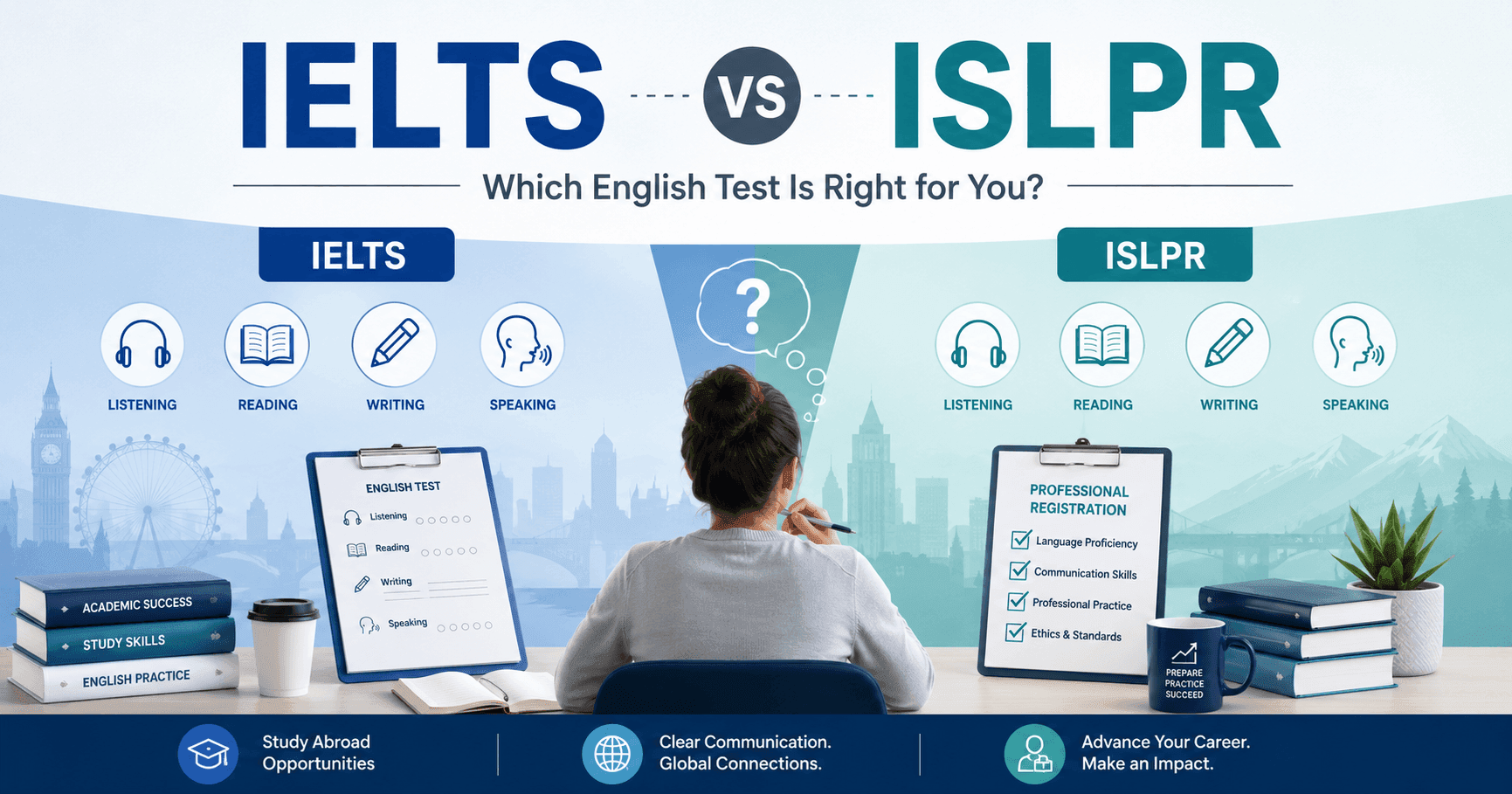
Choosing between IELTS and ISLPR can be confusing, especially if you need an English test result for study, migration, work, teacher registration or professional registration. Many candidates ask the same question: Should I take IELTS or ISLPR?
When considering IELTS vs ISLPR, it’s crucial to understand the implications for your future.
Many individuals often find themselves weighing their options between IELTS vs ISLPR.
This is an important decision. Choosing the wrong English proficiency test can cost you time, money and confidence. Some candidates prepare for the IELTS English test when the ISLPR English test may suit their situation better. Others focus on ISLPR when the IELTS Academic test may be the result required by their university, employer, migration pathway or professional registration body.
The right choice depends on your purpose, the requirements of the organisation asking for your result, and your personal strengths as an English user.
The debate around IELTS vs ISLPR continues to evolve as more people explore their options.
Before you book either test, always check the official requirements from the university, registration board, employer, visa authority, professional association or training provider that needs your English result. Do not choose a test simply because someone says it is easier. Choose the test that is officially accepted for your purpose.
IELTS vs ISLPR: The Main Difference
The simplest way to understand the difference between IELTS and ISLPR is this:
IELTS is a highly standardised international English test.
ISLPR is a personalised English proficiency test that assesses how well you use English in real-life and professional situations.
Both tests assess English language ability. Both can be used for serious academic, professional or migration-related purposes. However, they do not assess candidates in exactly the same way.
The IELTS test format is more fixed. Candidates know the sections, timing and question types before test day. This makes IELTS preparation more structured because you can practise specific question types repeatedly.
The ISLPR test format is more personalised. The test may connect more closely to your background, interests, profession, study area or real-life communication needs. This means ISLPR preparation often focuses less on memorising question types and more on using English naturally, clearly and appropriately.
So, the best question is not simply:
Understanding the nuances of IELTS vs ISLPR is essential for informed decision-making.
Is ISLPR better than IELTS?
Many candidates frequently discuss IELTS vs ISLPR to determine the best fit for their situations.
Or:
Is IELTS better than ISLPR?
Understanding the features of IELTS vs ISLPR can guide your decision-making process.
The better question is:
Which English test is right for me?
To answer that properly, you need to consider your goal, your required result, your strengths and the official requirements of the organisation asking for your English test result.
What Is IELTS?
IELTS stands for the International English Language Testing System. It assesses four skills:
- Listening
- Reading
- Writing
- Speaking
IELTS Academic is commonly used for university study and some professional registration purposes. IELTS General Training is often used for migration, work and general training purposes, depending on the requirements of the organisation.
In IELTS, Listening, Reading and Writing are usually completed together. The Speaking test may be on the same day or on a different day, depending on the test centre.
IELTS results are reported as band scores. Candidates receive a score for each skill and an overall band score.
For example, a candidate may receive:
- Listening: 7.5
- Reading: 7.0
- Writing: 6.5
- Speaking: 7.0
- Overall: 7.0
This scoring system is useful because many organisations state exactly what IELTS score they require. For example, a university or professional body may ask for an overall band score of 7.0, with no skill below 7.0. Another organisation may have a different requirement.
This is why IELTS candidates must always check the exact required band score before preparing for or booking the test.
What Is ISLPR?
ISLPR stands for International Second Language Proficiency Ratings. Like IELTS, it assesses four skills:
A thorough evaluation of IELTS vs ISLPR will help you make the most suitable choice.
- Speaking
- Listening
- Reading
- Writing
However, ISLPR is different from IELTS because it is interactive and personalised. Speaking, listening and reading are usually assessed through a one-to-one interview, while the writing test is completed separately.
The ISLPR English test is not simply about answering fixed question types. It focuses on how well candidates can use English in real-life situations.
For professional registration candidates, such as teachers, ISLPR may include topics related to education and professional practice. This is important because the English needed by teachers is not only general English. Teachers also need to explain ideas clearly, discuss student learning, communicate with parents, describe classroom situations and respond professionally.
If you are preparing for ISLPR for teacher registration, you should not only practise grammar and vocabulary. You should also practise speaking and writing about real educational issues.
For many candidates, the question of IELTS vs ISLPR is pivotal for their career paths.
When discussing IELTS vs ISLPR, consider your specific needs and goals.
IELTS Academic vs ISLPR: How Are They Different?
The IELTS and ISLPR difference becomes clearer when you compare how the two tests are structured.
IELTS has a fixed and predictable format. Candidates prepare for specific sections, such as:
- Listening
- Reading
- Writing Task 1
- Writing Task 2
- Speaking Part 1
- Speaking Part 2
- Speaking Part 3
Ultimately, the choice of IELTS vs ISLPR should align with your educational and career aspirations.
This structure is useful because candidates can practise each question type many times before test day.
For example, in the IELTS Academic test, Writing Task 1 usually asks candidates to describe visual information. This may include a graph, table, chart, process or map. Writing Task 2 requires candidates to write an essay.
IELTS preparation often focuses on mastering task types. Candidates need to understand the question, plan quickly, write clearly, manage time and meet the marking criteria.
ISLPR is different. It is less predictable because it is personalised. Candidates may be asked questions connected to their own experience, interests, studies, job or profession. In the writing test, the task may also reflect real-life or professional writing purposes.
Choosing between IELTS vs ISLPR can significantly impact your future opportunities.
For example, a teacher registration candidate may be asked to write about teaching practice, education, communication with parents, student learning, school policies or professional issues.
In simple terms:
IELTS preparation often focuses on mastering test question types.
ISLPR preparation focuses more on flexible English for real communication.
IELTS Test Format: Who Does It Suit?
The IELTS test format may suit candidates who prefer structure, timing and repeated practice. If you like knowing exactly what to expect in the test, IELTS may feel more manageable.
IELTS may be a good option if you are comfortable with:
- Timed reading
- Academic writing
- Formal test conditions
- Structured speaking questions
- Fixed question types
- Clear band score targets
IELTS may also suit you if you are applying for university study, migration or professional registration where IELTS is clearly listed as an accepted test.
For example, if a university says, “We require IELTS Academic overall 6.5, with no band below 6.0,” then IELTS is clearly relevant to your goal. In that situation, preparing for a different test will not help unless the university also accepts that test.
ISLPR Test Format: Who Does It Suit?
The ISLPR test format may suit candidates who are stronger in real communication than in fixed exam tasks. It may also suit candidates who need to demonstrate English in professional or workplace-related contexts.
ISLPR may be a good option if you are comfortable with:
- One-to-one interaction
- Explaining your ideas in conversation
- Discussing real-life topics
- Talking about your profession or study area
- Writing practical texts
- Responding naturally to follow-up questions
For teachers, ISLPR can be relevant because professional communication is central to teaching. Teachers need to discuss behaviour, learning, curriculum, inclusion, assessment, classroom support and communication with families.
This is why many candidates search for terms such as IELTS vs ISLPR for teachers, IELTS vs ISLPR for teacher registration in Australia, English proficiency test for teachers in Australia, and IELTS or ISLPR for overseas-trained teachers.
However, the first rule remains the same: ISLPR is only useful if the organisation asking for your result accepts it.
When Should You Choose IELTS?
You may choose IELTS if you need a test that is widely accepted internationally. It may suit you if you are applying for university study, migration, work or professional registration where IELTS is specifically listed.
Choose IELTS if:
- Your university, employer, visa pathway or professional body accepts or requires IELTS.
- You prefer a fixed test structure.
- You are comfortable practising repeated question types.
- You are confident with academic reading and writing.
- You can manage time well under exam conditions.
- You need an English test for professional registration where IELTS is accepted.
- You need IELTS for migration or international study.
- You want a test with clearly defined band scores.
IELTS may suit candidates who like organised preparation. You can prepare for IELTS Listening, IELTS Reading, IELTS Writing and IELTS Speaking using a clear structure. You can also target the band score required by your institution or registration authority.
If your goal is university admission, IELTS may be especially relevant. This is why many candidates compare IELTS vs ISLPR for university study before choosing a test.
When Should You Choose ISLPR?
You may choose ISLPR if the organisation asking for your English result accepts it and if the format suits your strengths.
Choose ISLPR if:
- Your registration authority, employer or institution accepts ISLPR.
- You are seeking professional registration through a pathway where ISLPR is recognised.
- You want an assessment connected more closely to real-life communication.
- You are a teacher or professional who needs to demonstrate English in workplace-related contexts.
- You are stronger in interactive communication than in fixed exam question types.
- You can explain your professional experience clearly.
- You can write in practical, real-life formats.
- You want to demonstrate how you use English in meaningful situations.
ISLPR may be especially relevant for some teacher registration candidates because it can connect to education-related communication. This is why candidates often research ISLPR for teacher registration, English test for teacher registration, and IELTS vs ISLPR for professional registration.
However, ISLPR is not automatically easier. It still requires strong English. You must be able to communicate clearly, accurately and appropriately across the required skills.
IELTS vs ISLPR Writing Test
The IELTS vs ISLPR writing test comparison is important because writing is often the skill that stops candidates from achieving their required result.
In IELTS Academic Writing, candidates usually complete two tasks. Task 1 asks candidates to describe visual information, such as a graph, table, chart, process or map. Task 2 asks candidates to write an essay in response to a question or issue.
This means IELTS Writing preparation needs strong control of:
- Task response
- Paragraph structure
- Academic vocabulary
- Grammar accuracy
- Coherence and cohesion
- Time management
- Clear introductions, overviews and conclusions
ISLPR Writing may be more connected to real-life or professional communication. Depending on the test purpose, candidates may need to write practical texts such as letters, reports, cases, outlines, submissions, professional explanations or other task types.
This means ISLPR Writing preparation needs strong control of:
- Purpose
- Audience
- Tone
- Organisation
- Clarity
- Practical language
- Professional relevance
- Accurate grammar and vocabulary
In both tests, writing is not only about grammar. You must answer the task clearly and organise your ideas logically.
IELTS vs ISLPR Speaking Test
The IELTS vs ISLPR speaking test comparison is also important.
IELTS Speaking has a structured format. Candidates answer personal questions, speak for a short extended turn, and then discuss broader or more abstract issues. This format allows candidates to practise the three parts of the test before test day.
ISLPR Speaking is more interactive and personalised. Candidates may discuss topics connected to everyday life, personal experience, study, work or professional background. The conversation may feel more natural, but candidates still need to demonstrate clear and accurate English.
For IELTS Speaking, candidates should practise:
- Giving direct answers
- Extending responses
- Using examples
- Speaking fluently
- Using accurate grammar
- Developing vocabulary
- Handling abstract questions
For ISLPR Speaking, candidates should practise:
- Explaining real experiences
- Responding naturally to follow-up questions
- Discussing professional topics
- Clarifying ideas
- Giving examples
- Speaking clearly and appropriately
- Avoiding memorised answers
In both tests, memorised answers can be a problem. They often sound unnatural and may not answer the exact question.
Practical Example 1: A Teacher Registration Candidate
Imagine a teacher named Maria.
Maria trained overseas and wants teacher registration in Australia. She is told that she needs to provide evidence of English language proficiency.
Her first mistake would be to ask: Which test is easier?
That is not the best starting point.
Instead, Maria should ask:
- Which English tests does my registration authority accept?
- What exact scores or ratings do they require?
- Do they require all four skills?
- Are there conditions about test date, test type or minimum result?
- Can results from different tests be combined, or must they come from one test sitting?
In summary, the discussion of IELTS vs ISLPR is one of great importance.
If the authority accepts both IELTS and ISLPR, Maria then needs to think strategically.
If she is strong with academic reading, essay writing and fixed test practice, IELTS may suit her. If she communicates well in professional conversations and wants a test connected to real-life teaching language, ISLPR may suit her.
Maria should not choose based on rumours. She should choose based on official requirements and honest self-assessment.
Practical Example 2: A University Applicant
Evaluating IELTS vs ISLPR will empower you to make a more strategic decision.
Now imagine a student named Daniel.
Daniel wants to study a Master’s degree overseas. The university website lists IELTS Academic as an accepted English test. It may also list other tests, but ISLPR may not appear.
In Daniel’s case, the decision is simple. He should prepare for the test that the university accepts.
Even if Daniel likes the idea of ISLPR, it will not help him if his university does not accept it.
This is why the first rule is always: Check the requirement before choosing the test.
Do not prepare for a test simply because someone says it is easier. Prepare for the test that actually helps you reach your goal.
IELTS or ISLPR for Migration?
Many candidates also compare IELTS vs ISLPR for migration. The key point is that migration requirements are set by the relevant immigration authority, not by test preparation teachers, friends or online rumours.
If you need an English test for migration, check the official visa or migration requirements carefully. Confirm which tests are accepted, what score is required, whether the result must be recent, and whether all skills must meet a minimum level.
IELTS may be more commonly recognised in many migration contexts, but you should never assume. Always check the exact requirement for your situation.
IELTS and ISLPR Preparation Tips
Good preparation starts with choosing the right test. Once you know whether you need IELTS or ISLPR, your study plan should match the test format.
1. Start with the required result
Do not begin by buying books or watching random videos. Start by writing down the exact result you need.
For IELTS, that may be something like:
Overall 7.0, with no band below 7.0.
For ISLPR, it may be a required rating in each skill.
Once you know the required result, identify your weakest skill. Many candidates fail because they prepare generally. Strong candidates prepare specifically.
2. Do a skill audit
Divide your English into four skills:
- Listening
- Reading
- Writing
- Speaking
Then ask yourself:
- Which skill is strongest?
- Which skill is weakest?
- Which skill has stopped me before?
- Which skill is most important for my target score or rating?
For IELTS, many candidates struggle with Writing Task 2 because they do not answer the question directly, develop clear paragraphs or use accurate grammar.
For ISLPR, some candidates struggle because they cannot explain professional ideas naturally. Their grammar may not be terrible, but their answers may not be clear, organised or detailed enough.
3. Practise under real conditions
For IELTS, practise with strict timing. In Reading, do not spend too long on one passage. You need to manage the whole test.
For Writing Task 2, practise planning quickly, writing clearly and checking your grammar before time runs out.
For Speaking, practise giving direct answers, extending ideas and using natural examples.
For ISLPR, practise real-life communication. If you are a teacher, practise explaining:
- How you manage behaviour
- How you support students with additional needs
- How you communicate with parents
- How you plan lessons
- How you respond to classroom challenges
This is not memorisation. It is professional English practice.
4. Do not memorise full answers
This is important for both tests.
Memorised answers often sound unnatural. They may also fail to answer the exact question.
Instead, prepare flexible language. For example, instead of memorising one full answer about teaching, practise useful sentence patterns such as:
- One challenge teachers face is…
- In my experience, students learn better when…
- A practical example of this is…
- I would respond by…
- The main reason is…
These sentence patterns can help you speak and write more clearly. They help you sound prepared without sounding robotic.
5. Match your practice to your test
If you choose IELTS, practise IELTS-style tasks. General English helps, but IELTS has specific task demands. You must understand the question types, timing, marking criteria and expected response structure.
If you choose ISLPR, practise real communication. Read education articles, discuss professional issues, write practical texts and record yourself explaining ideas. Then check your clarity, grammar, vocabulary and organisation.
Your preparation should not look exactly the same for both tests.
Common Mistakes Candidates Make
Mistake 1: Choosing a test because someone said it is easier
This is dangerous. A test that is easy for one person may be difficult for another.
A candidate who enjoys structured exam tasks may prefer IELTS. A candidate who communicates better in personalised discussion may prefer ISLPR.
Choose based on fit, not gossip.
Mistake 2: Ignoring the organisation’s requirement
This is the biggest mistake.
If your university, employer or registration body does not accept a particular test, then your result may not help you. Always confirm the accepted tests and required scores before booking.
Mistake 3: Preparing only for writing
Writing is important, but you need all the required skills.
For IELTS, a weak score in one skill can stop you from meeting the requirement, even if your overall score looks good.
For ISLPR, each skill is assessed separately, so do not neglect speaking, listening or reading.
Mistake 4: Using only generic English practice
Watching English movies can help. Reading articles can help. Speaking with friends can help.
However, high-stakes English tests need targeted preparation. You need to practise the actual type of communication required in the test.
How to Choose Between IELTS and ISLPR
If you are still asking, “Should I take IELTS or ISLPR?”, use this decision process.
Step 1: Check which tests are accepted
Start with the organisation asking for your English result. This may be a university, employer, registration board, professional body or visa authority.
Do not rely only on comments from friends, social media groups or old information. Requirements can change.
Step 2: Check the exact required score or rating
For IELTS, check the required overall band score and the minimum score for each skill.
For ISLPR, check the required rating for each skill and any conditions attached to the test result.
Step 3: Compare the test format with your strengths
If you are strong in structured academic tasks, IELTS may suit you.
If you are strong in professional discussion and real-life communication, ISLPR may suit you, provided it is accepted for your purpose.
Step 4: Consider your preparation time
IELTS and ISLPR both require serious preparation. Neither test should be treated as a shortcut.
Ask yourself whether you have enough time to improve your weakest skill before booking the test.
Step 5: Prepare specifically for the chosen test
Once you choose a test, stop preparing randomly. Follow a focused preparation plan that matches the test format, required score and your weakest areas.
Which English Test Should Teachers Take?
Many overseas-trained teachers ask: Which English test should teachers take?
The answer depends on the teacher registration authority and its accepted English test options.
For some teachers, IELTS may be the right choice because it is widely recognised and has a structured test format. For others, ISLPR may be a suitable option if it is accepted for teacher registration and if the candidate performs well in professional communication contexts.
For teachers, the choice of IELTS vs ISLPR is especially significant.
This is why IELTS vs ISLPR for teachers is not a simple question of easier or harder. It is a question of acceptance, suitability and preparation.
If you are a teacher, do not choose your test based only on what another teacher did. Your registration pathway, required result, current English level and test strengths may be different.
Quick Self-Check Before Choosing IELTS or ISLPR
Before you choose IELTS or ISLPR, answer these five questions:
Preparing for IELTS vs ISLPR requires an understanding of each test’s format.
- What organisation is asking for my English result?
- Which tests does that organisation officially accept?
- What score or rating do I need in each skill?
- Am I stronger in structured exam tasks or personalised communication?
- Do I have enough time to prepare properly for this test?
If you cannot answer these questions, you may not be ready to book the test yet.
Final Thoughts: IELTS vs ISLPR
So, IELTS vs ISLPR: Which English Test Is Right for You?
The answer depends on your goal, your required result and your personal strengths.
IELTS is structured, widely recognised and exam-format driven. It may suit candidates who need an accepted test for university study, migration, work or professional registration and who are comfortable with fixed test conditions.
ISLPR is interactive, personalised and focused on real-life language use. It may suit candidates, including some teachers and professionals, who need to demonstrate English in practical and professional contexts, provided ISLPR is accepted for their purpose.
Both tests require serious preparation. Neither test should be treated as a shortcut.
Before making your decision, check the official requirements from the organisation that needs your result. Then choose the test that is accepted, suitable for your situation and realistic for your strengths.
If you are preparing for IELTS or ISLPR, the most important thing is not just to study harder. It is to prepare for the right test in the right way.
Your choice between IELTS vs ISLPR should reflect your language proficiency goals.
Thus, the final decision on IELTS vs ISLPR ultimately belongs to you.