
In this lesson, you will learn how to write a clear, organised and professional formal letter for an ISLPR-style Writing Test. Formal letters are important because they test your ability to communicate appropriately in real-life situations, especially in professional, educational and community contexts.
A formal letter may ask you to:
- request information
- make a complaint
- explain a situation
- respond to a concern
- apologise formally
- make a recommendation
- inform a parent, colleague, manager or official
- give advice in a professional setting
In the ISLPR Writing Test, your task is not simply to “write beautifully”. Your main goal is to communicate clearly, appropriately and accurately for the situation.
1. What Is a Formal Letter?
A formal letter is a professional written message sent to someone you do not know well, or to someone in an official role.
Formal letters are usually written to people such as:
- a school principal
- a parent or guardian
- a government officer
- a registration board
- a manager or supervisor
- a colleague in a formal workplace situation
- a community organisation
- a service provider
A formal letter has a clear purpose. The reader should quickly understand:
- who is writing
- why the letter is being written
- what information is being provided
- what action is expected, if any
2. Common Types of Formal Letters in ISLPR-Style Writing
1. Letter of Complaint
This letter explains a problem and requests action.
Example situation:
You attended a professional development workshop, but the materials were not provided as promised. Write to the organiser explaining the issue and requesting a solution.
2. Letter of Request
This letter asks for information, permission, support or action.
Example situation:
You are a teacher requesting permission from the principal to organise an excursion for your students.
3. Letter of Explanation
This letter explains a situation clearly and professionally.
Example situation:
A parent has asked why their child was moved to another reading group. Write a formal letter explaining the reason.
4. Letter of Apology
This letter acknowledges a mistake or inconvenience and explains what will be done next.
Example situation:
You are writing to a parent because a school notice was sent late.
5. Letter of Recommendation or Support
This letter supports a person, proposal or action.
Example situation:
You are recommending a student for a leadership opportunity or supporting a colleague’s application for a program.
6. Letter to an Authority or Organisation
This letter communicates with an official body.
Example situation:
You are writing to an education office about the need for more learning support resources in your school.
3. Parts of a Formal Letter
A strong formal letter should include the following parts.
A. Sender’s Address
This is the address of the person writing the letter. In a real test, you may invent a simple address if needed.
Example:
12 River Street
Parramatta NSW 2150
You do not need to use your real address in a practice test.
B. Date
Write the date clearly.
Example:
24 June 2026
C. Receiver’s Address
This is the address or position of the person receiving the letter.
Example:
The Principal
Green Valley Primary School
45 School Road
Sydney NSW 2000
If you do not know the exact address, you can use a realistic role and organisation.
D. Greeting or Salutation
Use a formal greeting.
Examples:
Dear Principal,
Dear Ms Williams,
Dear Sir/Madam,
Dear Registration Officer,
Use Dear Sir/Madam only when you do not know the person’s name or title.
E. Subject Line
A subject line helps the reader understand the topic quickly.
Examples:
Subject: Request for Additional Classroom Support
Subject: Concern Regarding Student Attendance
Subject: Application for Professional Development Leave
Subject: Complaint About Delayed Service
The subject should be short, clear and specific.
F. Opening Paragraph
The opening paragraph should state the purpose of the letter immediately.
Weak opening:
I am writing this letter because there are many things I want to say about the issue that happened recently.
Better opening:
I am writing to request additional classroom support for a student in Year 4 who requires assistance with communication, transitions and independent learning tasks.
The better opening is clear, direct and professional.
G. Main Body Paragraphs
The body of the letter should give details. Usually, you need two or three body paragraphs.
A good body should:
- explain the situation
- give relevant background information
- provide reasons or examples
- avoid unnecessary personal emotion
- stay focused on the task
- use polite and professional language
H. Final Paragraph
The final paragraph should explain what you want to happen next.
Examples:
I would appreciate your advice on the next steps.
I would be grateful if this matter could be reviewed before the end of the week.
Please let me know if you require any further information.
I look forward to your response.
I. Closing
Use a formal closing.
Examples:
Yours sincerely,
Ronald Kaunda
Yours faithfully,
Ronald Kaunda
Use Yours sincerely when you know the person’s name or title.
Use Yours faithfully when you begin with Dear Sir/Madam.
4. Formal Letter Structure
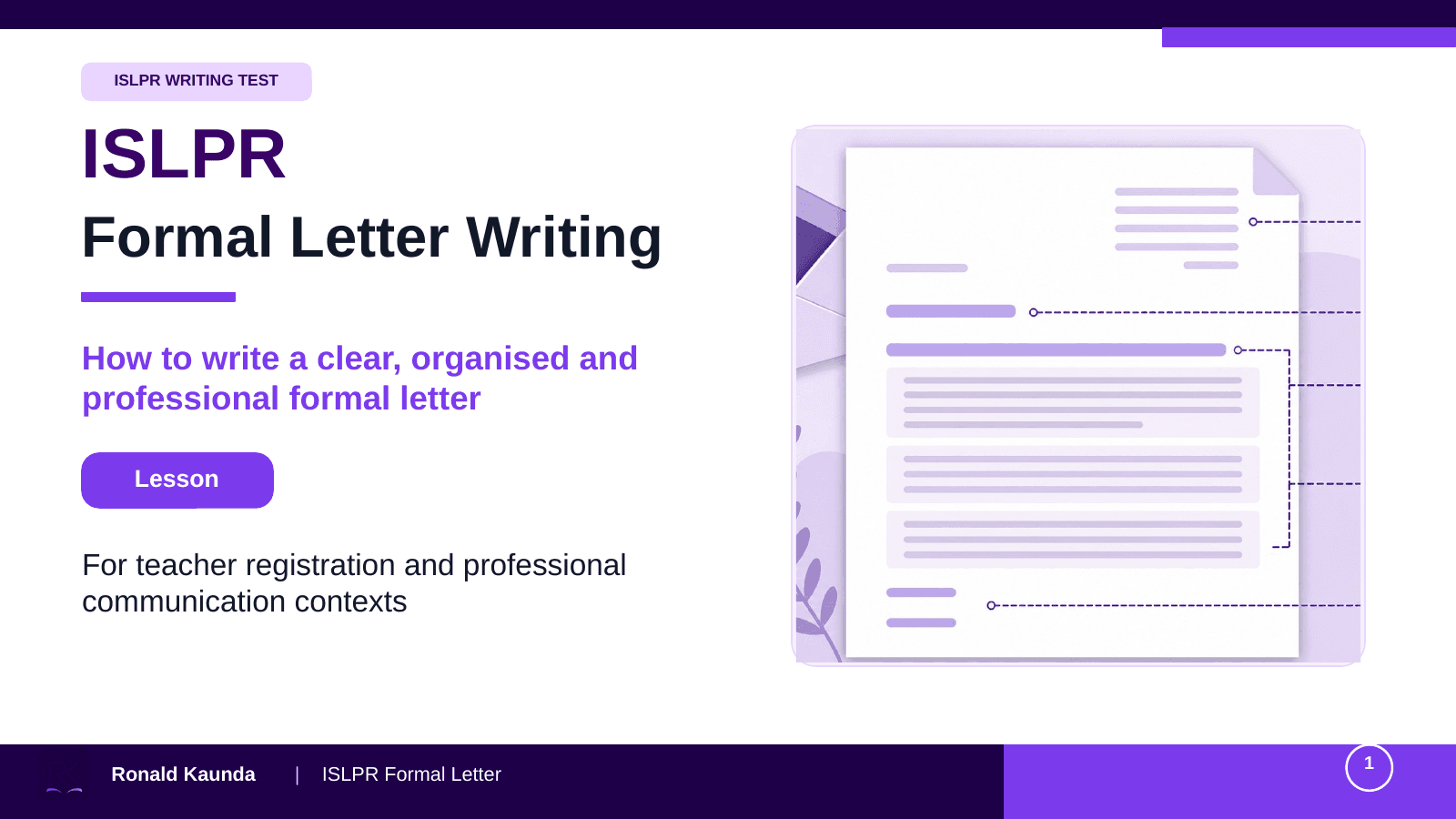
Use this structure in the test:
Sender’s address
Date
Receiver’s name/title
Receiver’s organisation/address
Greeting
Subject: Clear topic of the letter
Paragraph 1: Purpose of the letter
State why you are writing.
Paragraph 2: Background and details
Explain the situation clearly.
Paragraph 3: Request, recommendation or action needed
Say what you want the reader to do.
Final sentence: Polite closing statement
Closing
Your name
5. Formal Language: What to Use and What to Avoid
Use formal language
Instead of:
I’m writing because I’m not happy about what happened.
Write:
I am writing to express my concern about the incident that occurred on Monday afternoon.
Instead of:
Can you fix this quickly?
Write:
I would appreciate it if this matter could be addressed as soon as possible.
Instead of:
The meeting was a mess.
Write:
The meeting was not well organised, and several important agenda items were not addressed.
Instead of:
You people did not help us.
Write:
The support provided did not fully meet the needs of the students.
6. Useful Formal Letter Phrases
To state the purpose
I am writing to request…
I am writing to express my concern about…
I am writing in relation to…
I am writing to provide information about…
I am writing to seek clarification regarding…
To explain the situation
The issue began when…
This matter is important because…
It has come to my attention that…
The main concern is that…
As a result, students have experienced…
To make a request
I would appreciate it if…
I would be grateful if you could…
I kindly request that…
Could you please provide…
I would like to ask whether…
To close the letter
Thank you for your attention to this matter.
I look forward to your response.
Please let me know if further information is required.
I would appreciate your consideration of this request.
7. Guided Example 1: Analysing the Task
ISLPR-Style Practice Task
Word limit: 150–180 words
You are working as a teacher aide in a school. One of your students has been having difficulty settling into class after lunch. Write a formal letter to the classroom teacher explaining the problem and suggesting one practical strategy to support the student.
Your letter should:
- explain the problem
- describe when it usually happens
- suggest one practical strategy
- use a polite and professional tone
Step 1: Identify the Audience
The audience is the classroom teacher.
This means the tone should be professional but not overly distant.
Suitable greeting:
Dear Ms Taylor,
Step 2: Identify the Purpose
The purpose is to explain a student concern and suggest a support strategy.
The letter is not a complaint. It is a professional communication.
Step 3: Plan the Paragraphs
Paragraph 1: State the reason for writing.
Paragraph 2: Explain the problem and when it happens.
Paragraph 3: Suggest one strategy and close politely.
Step 4: Model Answer
12 Hill Street
Melbourne VIC 3000
24 June 2026
Ms Taylor
Classroom Teacher
Riverbank Primary School
Dear Ms Taylor,
Subject: Support for Student Transition After Lunch
I am writing to share a concern about one of our students, who has been finding it difficult to settle back into class after lunch. This has occurred several times over the past two weeks and appears to affect his readiness for learning in the afternoon session.
The difficulty usually begins when the class lines up after lunch. The student often becomes unsettled, walks away from the group or needs repeated reminders before entering the classroom. Once inside, he may take extra time to begin the first learning task.
One strategy that may help is to provide him with a simple visual transition card before the bell. This could remind him of the steps: line up, enter the room, sit at the desk and begin the first task. I would be happy to support this routine each day.
Thank you for considering this suggestion.
Yours sincerely,
Ronald Kaunda
Why This Letter Works
This letter works because it:
- answers all parts of the task
- uses a formal but respectful tone
- gives a clear reason for writing
- explains the problem without blaming the student
- suggests one realistic strategy
- stays within the word limit
- uses clear paragraphs
8. Guided Example 2: Improving a Weak Response
Weak Response
Dear Teacher,
I am writing because the student is not behaving well after lunch. He does not listen and always makes problems. I think you should do something because it is becoming too much. Maybe give him a warning or keep him inside. I hope you fix this.
From Ronald
Problems With This Response
The response is weak because:
- the tone is too informal and negative
- it blames the student
- it does not give enough detail
- the suggestion is not clearly supportive
- the closing is not formal
- it does not sound professional
Improved Version
Dear Ms Taylor,
Subject: Support for Afternoon Classroom Transition
I am writing to discuss a concern regarding one student’s transition back into class after lunch. Over the past two weeks, he has needed additional support to line up, enter the classroom and begin the afternoon learning task.
This behaviour appears to occur mainly after the lunch break, particularly when the playground is noisy and the class is moving quickly. He responds better when instructions are short, calm and supported with visual reminders.
I suggest using a simple visual checklist before the bell to prepare him for the transition. I am happy to help him follow this routine each day and monitor whether it improves his readiness for learning.
Yours sincerely,
Ronald Kaunda
9. Exam-Focused Tips for ISLPR Formal Letters
Tip 1: Read the task carefully
Before you write, underline or mentally identify:
- who you are writing to
- why you are writing
- what details must be included
- what tone is needed
- the word limit
Do not start writing immediately. Spend two or three minutes planning.
Tip 2: Match the tone to the reader
A letter to a parent should be respectful and reassuring.
A letter to a principal should be professional and concise.
A letter of complaint should be firm but polite.
A letter to a government office should be formal and clear.
Tip 3: Do not over-explain
In a short ISLPR writing task, you do not have space for too much background information. Give enough detail to answer the task, but stay focused.
Tip 4: Use paragraphing
Do not write one long block of text.
Use clear paragraphs:
- purpose
- details
- request or next step
Good paragraphing makes your writing easier to read and shows control.
Tip 5: Avoid emotional language
Formal writing should not sound angry, rude or dramatic.
Avoid:
This is terrible.
Nobody cares.
You must fix this now.
The school is doing nothing.
Use:
I am concerned about this matter.
I would appreciate your support.
This issue requires further attention.
I would be grateful if this could be reviewed.
Tip 6: Check grammar and punctuation
At the end, check:
- capital letters
- full stops
- subject-verb agreement
- verb tense
- spelling
- sentence clarity
- formal tone
- whether you answered every part of the task
10. Practice Task 1
Formal Letter of Request
Word limit: 150–180 words
You are working in a school. Some students in your class need extra reading support. Write a formal letter to the principal requesting additional reading resources.
Your letter should:
- explain why the resources are needed
- describe the type of resources required
- explain how the resources will support students
- use a formal tone
Planning Notes
Audience: Principal
Purpose: Request resources
Tone: Formal and respectful
Suggested structure:
Paragraph 1: State the request
Paragraph 2: Explain the need
Paragraph 3: Explain the benefit and close politely
11. Practice Task 2
Formal Letter of Complaint
Word limit: 220–250 words
You recently attended an online professional development session for teachers. The session started late, the materials were not provided, and some important topics were not covered. Write a formal letter to the organiser explaining your concerns and requesting a response.
Your letter should:
- explain why you are writing
- describe two problems with the session
- explain how these problems affected participants
- request a solution or response
- use a polite but firm tone
12. Practice Task 3
Formal Letter to a Parent
Word limit: 150–180 words
You are a teacher writing to a parent about their child’s improved participation in class. Write a formal letter explaining the improvement and suggesting one way the parent can continue supporting the child at home.
Your letter should:
- explain the positive change
- give one example from class
- suggest one home support strategy
- use a respectful and encouraging tone
13. Final Checklist for Formal Letters
Before you finish your ISLPR-style formal letter, check the following:
- Have I included the correct greeting?
- Have I included a clear subject line?
- Is my purpose clear in the first paragraph?
- Have I answered all parts of the task?
- Is my tone formal and respectful?
- Have I used paragraphs?
- Have I made a clear request, suggestion or explanation?
- Have I used an appropriate closing?
- Is my writing within the word limit?
- Have I checked grammar, punctuation and spelling?
Key Point to Remember
A strong ISLPR formal letter is not about using complicated English. It is about using clear, accurate and appropriate English for a real-life situation. In the test, show that you can communicate professionally, organise your ideas logically and respond fully to the task.